
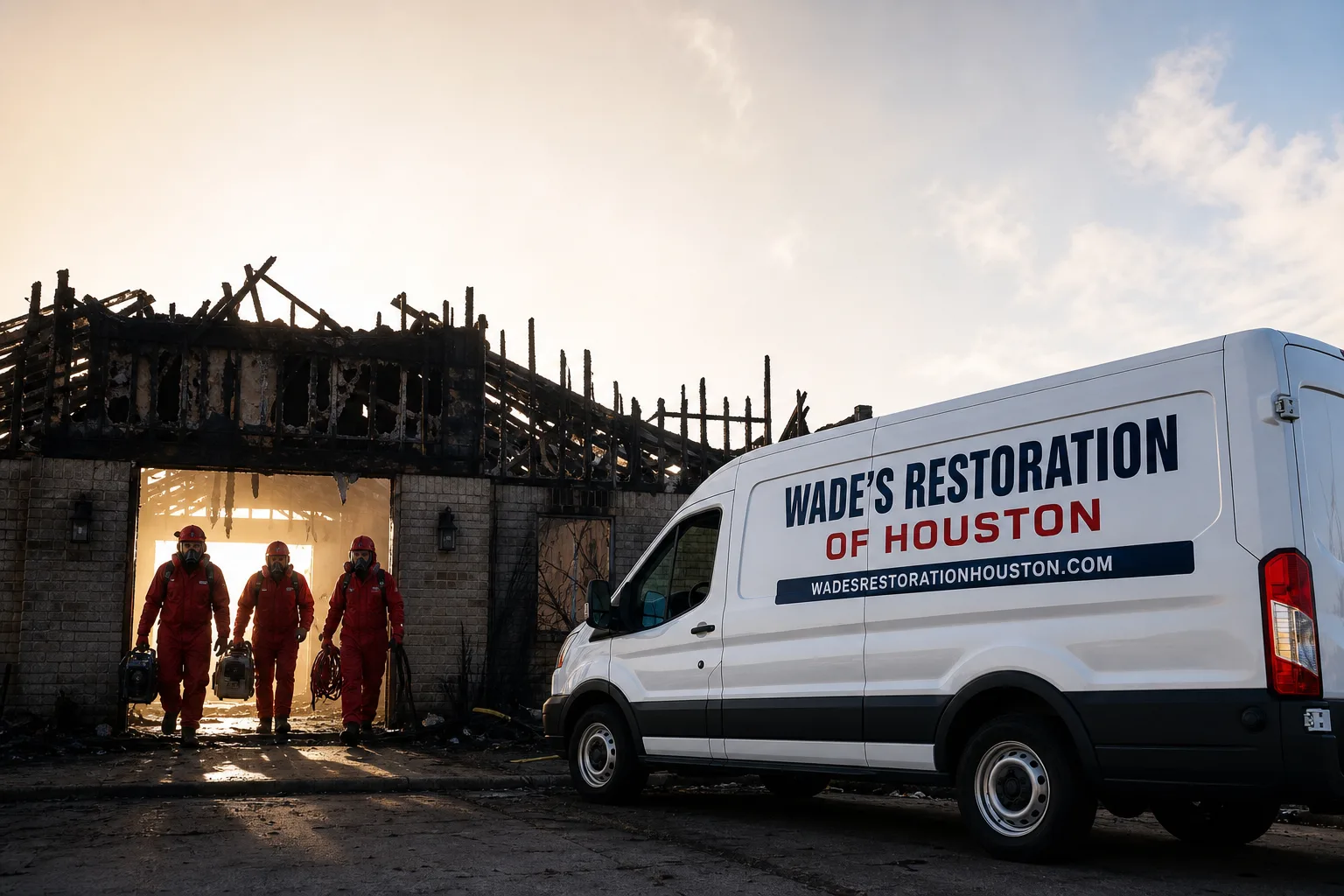
Fast, Reliable Storm & Disaster Restoration Across El Campo
Storm damage in El Campo doesn’t wait for business hours, and neither do we. When a tropical system stalls over Wharton County and water starts pushing against your slab, call (888) 534-8116. We answer live, 24/7, and Wade heads out himself. Flood damage restoration in El Campo typically starts with emergency extraction and runs $3,200-$7,800 depending on square footage, and we can have equipment running inside the hour. No voicemail, no answering service, no runaround. You get a real person who knows El Campo’s clay soil and canal systems, and who will show up with the right drying equipment the first time.
Why Wade’s Restoration of Houston Is the Storm & Disaster Restoration Team El Campo Calls First
El Campo is a town where folks still ask around before hiring anyone. Ask anyone on your street about Storm & Disaster Restoration and you’ll hear the same thing: Wade shows up, does what he says, and stands behind the work. We’ve worked on 1950s ranch homes off FM 2540, brick-veneer bungalows near the downtown square, and acreage properties outside the 77437 zip code where driveways are long and the nearest neighbor is a quarter mile of rice field.
We know that in El Campo, storm damage rarely stops at the front door. It comes through slab edges, weeps into baseboards, and fills window wells with silty canal overflow. Our response time to most El Campo properties is under 90 minutes because we stage equipment within the county during severe weather watches. Wade Ferris founded this company in 2007, publishes his name and license number, and answers his own phone at two in the morning. That’s not customer service, that’s being a neighbor.
Our Storm & Disaster Restoration Services in El Campo
Flood Damage Restoration
When the irrigation canals east of town overtop, they don’t just bring water, they push fine clay-silt from the rice fields into residential streets. Flood damage restoration in El Campo runs $3,200-$7,800 for a typical 1,500-2,200 square foot ranch home, but the real cost driver is what’s hiding in the slab. We map moisture along foundation perimeters and utility penetrations before we declare anything dry. Standard riverine flood response doesn’t work here. The water doesn’t recede, it saturates the black clay and wicks back through slab-edge gaps days later, so we use Injectidry wall drying mats and Dri-Eaz dehumidifiers to chase moisture where municipal flood crews never look.
Storm Damage Cleanup
Wind-driven debris, downed limbs, and roofing material scattered across a two-acre lot is common after a severe line moves through Wharton County. Storm damage cleanup in El Campo starts around $800 for basic debris removal and can run $3,500+ when the damage is spread across acreage with damaged outbuildings. We screen for clay-silt contamination embedded in flooring and lower wall assemblies because what looks like dried mud after a canal overtop is often mixed with agricultural runoff that keeps damaging finishes and feeding mold long after the water is gone.
Emergency Board-Up
Windows blow out, garage doors cave, and a tarp is only as good as the structure holding it. Emergency board-up in El Campo runs $450-$1,200 depending on the number of openings and whether we’re securing glass, plywood, or both. We carry stock sized for the older ranch homes common on El Campo’s residential streets, and we cut on site rather than making you wait for a supply run to Wharton. When a storm has already taken a window, you can’t wait until the next weather system moves through to get the opening sealed.
Roof Tarping
A compromised roof over a 1960s ranch home with original framing needs attention before the next squall line. Roof tarping in El Campo runs $350-$850 for a standard single-story home, depending on pitch and access. On acreage properties with detached workshops and storage barns, we often tarp multiple structures in one trip. The clay soil means standing water sits against fascia boards and soaks upward, so we check overhang damage while the ladders are already up.
What happens when you call
- 1
A real person answersNo phone trees - you reach a local pro.
- 2
You get an upfront price rangeHonest numbers before anyone is dispatched.
- 3
A background-checked tech heads outLicensed & insured, dispatched right away.
- 4
You approve before work beginsNothing starts until you say go.
Trusted Brands We Service in El Campo
El Campo homeowners tend to own equipment built for work: Dri-Eaz dehumidifiers in the laundry room, a B-Air mover in the workshop, an Injectidry mat system for when the hot water heater flooded the garage. We service what we use ourselves. Our trucks carry the same equipment we rely on daily, from Phoenix and XPOWER air movers to Injectidry injection-drying panels, and we keep stock sized for the slab-on-grade homes that dominate El Campo housing. No waiting on a parts delivery from Houston while your sheetrock sits wet.
Common Storm & Disaster Restoration Problems We See in El Campo Homes
- Water pushing through slab-edge gaps and weep holes. El Campo’s black clay soil expands and shrinks with moisture cycles, leaving persistent gaps at foundation perimeters. When a tropical system sheets water across saturated ground, that water finds those gaps and wicks into wall cavities, so we map the slab perimeter on every flood job we touch in 77437.
- Hidden saturation that shows up days after the water’s gone. Flat terrain means water doesn’t drain, it sheets and sits. A home can look dry while the underlying black clay stays saturated, and that moisture wicks back through the slab edge three days later. Our daily moisture readings catch this before it turns into a punch-list surprise.
- Fine clay-silt contamination from canal overtopping. When the irrigation network around El Campo overflows, it carries rice-field silt into homes. That residue is fine enough to embed in carpet backing and drywall paper, and standard extraction won’t touch it. You have to physically remove affected materials, not just dry them.
- Mold colonization inside 48 hours. With year-round humidity above 75% and over 50 inches of annual rainfall, El Campo is a mold pressure cooker. A saturated wall cavity left uncontained for two days becomes a remediation project. We set containment early, always, because in this climate the clock moves faster than most people realize.
Pricing for Storm & Disaster Restoration in El Campo, TX
We Also Serve Cities Near El Campo
We regularly handle storm and flood restoration in Wharton, Bay City, Rosenberg, and Greatwood, though El Campo’s clay-soil and canal flooding issues tend to be the most persistent. The same crew responds, the same equipment comes off the truck, and the same 90-Day Done Right Promise applies. If you’re nearby and looking for flood damage restoration, give us a call.
Serving El Campo, TX - Our Local Coverage Area
We’re based in the El Campo area and know this community well. Use the map below to see our service coverage - if you’re nearby, we can almost certainly help.
FAQs - Storm & Disaster Restoration in El Campo
Black clay soil doesn’t drain, it holds water and swells, which means our Water Damage Restoration in El Campo focused only on surface water will fail within days. We map moisture along the entire slab perimeter and at utility penetrations, then use injection drying and dehumidification to pull moisture from the clay before it can wick back through slab-edge gaps. This adds time and labor compared to a riverine flood response, but skipping it is how homes “dry” for a week and then grow mold behind baseboards. Call (888) 534-8116 and ask us to walk the slab with you before you sign anything.
Silt cleanup from canal overflow means removing contaminated materials rather than just drying them, because fine agricultural sediment embeds in carpet backing, drywall paper, and subfloor seams. We cut and remove affected porous materials, HEPA-vacuum hard surfaces, and run air scrubbers during the process because that silt carries organic material that feeds mold. This is one of the most common unexpected costs for El Campo homeowners, and it’s also one of the most frequently skipped steps by restoration crews unfamiliar with the area. We don’t skip it.
Roof tarping and board-up will stabilize your home temporarily and stop further water intrusion, but they won’t address water that’s already in the wall cavities or slab. In El Campo’s humidity, any water that entered before the tarp went on needs moisture mapping and likely drying equipment. The tarp buys you time; the Reconstruction & Cleanup in El Campo assessment is what tells you whether you’re facing a dry-out job or a full rebuild.
Weep holes and foundation gaps in older slab-on-grade homes become direct water pathways during sheet flooding, so we focus extraction there first, then keep water from re-entering while the slab dries. That often means blocking weep holes temporarily, cutting small access points at the slab edge, and running dehumidifiers on both sides of the slab. In a 1972 ranch home off a farm-to-market road, this meant a full week of monitoring and drying rather than a two-day extraction, but the homeowner didn’t get a second intrusion.
Call (888) 534-8116 before you do anything else. Turn off power to affected areas only if you can do so safely without standing in water, then get extraction started, because in El Campo’s 75%+ humidity the mold window is 24-48 hours. Don’t move wet carpet or drywall yourself if you can avoid it; the silt in that floodwater is a biohazard you don’t want spread across the rest of the house. We’ll have someone there fast, and we’ll tell you what to leave alone before we arrive.
Written by Wade Ferris, Owner at Wade’s Restoration of Houston, serving El Campo and the surrounding Wharton County area.