
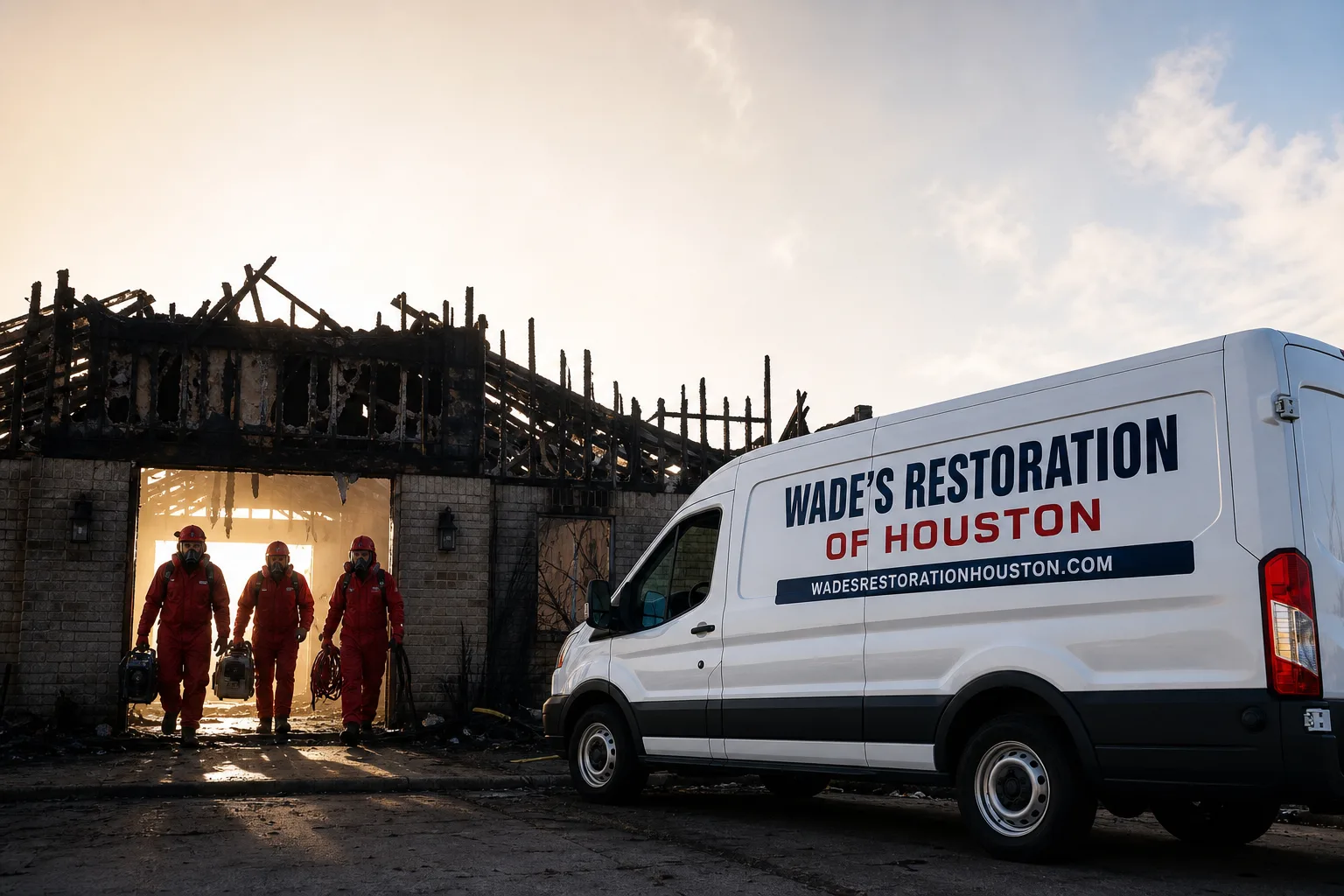
Fast, Reliable Water Damage Restoration Across Highlands
Water damage in Highlands doesn’t wait, and neither do we. When the San Jacinto River rises or a pipe lets go at 2 a.m., you need someone who knows this town’s specific problems: floodwater that may carry contaminant sediment from the San Jacinto River Waste Pits Superfund site, pier-and-beam homes that hide moisture for months, and humidity that turns damp drywall into mold in 48 hours. Wade’s Restoration of Houston sends crews to Highlands fast, with extraction equipment running inside the hour in most cases. Call (888) 534-8116 and you’ll get a live person on the line, day or night.
We’ve worked Highlands homes after Harvey, after Tax Day 2016, after Memorial Day 2015. We know what river flooding does to a wood-frame house built in the 1950s, and we know what it takes to dry it out right, not just fast. More on that below.
Why Highlands Homeowners Call Wade’s Restoration First
Wade Ferris founded this company in 2007, and he still answers his own phone. That matters in a town like Highlands, where the person who shows up at your door is going to be the person you see at the hardware store next Saturday. We’re not a national chain with a call center in another state. We’re local, owner-operated, and our name is on every truck that heads into 77562.
Highlands residents have dealt with enough after a flood without getting upsold by a crew that just pulled into town. Wade’s approach is straight: a written scope before work starts, daily moisture readings logged and handed to you when the job is done, and Wade himself dealing with your insurance adjuster so you’re not stuck relaying messages between two sides. Ask anyone on Fairmont Parkway or Garth Road who’s used us. We’ve earned our reputation one flood at a time.
Every water damage job we do in Highlands carries the 90-Day Done Right Promise, in writing. If it’s not done right, Wade makes it right. That’s not a slogan. It’s stamped on every contract.
Our Water Damage Restoration Services in Highlands
Here’s what we do for Highlands homes and businesses, and why it matters in this specific town.
Emergency Water Extraction
Water doesn’t lose depth in Highlands on its own. Whether it’s a burst supply line over a pier-and-beam crawl space or three feet of San Jacinto river water across a slab, the first move is getting the water out. We run truck-mounted extraction units and high-volume pumps that pull hundreds of gallons per hour. In Highlands we arrive knowing the water may not be clean. That changes the protocol from minute one, including where we stage equipment and how we handle initial sediment.
Structural Drying & Dehumidification
Drying a Highlands home properly means understanding what’s underneath it. Pier-and-beam foundations, common in the 1940s through 1970s housing stock here, trap moisture in crawl spaces that slab homes never deal with. We use Dri-Eaz dehumidifiers and XPOWER air movers positioned to dry wall cavities, subfloors, and the crawl space itself. Wade’s crew takes moisture readings every single day and logs them. At the end of the job, that log is yours. Almost no one else in the trade does that.
Flood Cleanup
Flood work in Highlands is different from anywhere else in Harris County. The San Jacinto River Waste Pits Superfund site sits immediately upstream. Floodwater receding through Highlands can carry dioxin-contaminated sediment into homes. That means before we treat flood cleanup as ordinary water removal, we collect sediment samples for EPA-compliant testing. Only after the lab clears it as non-hazmat do we proceed with full structural drying, debris removal, and mold treatment. On a pier-and-beam home near the riverbank, our crew found the crawl space filled with fine gray silt after a flood. We collected samples first, then ran extraction and drying. That’s the standard every Highlands flood job requires, and skipping it is how a contractor spreads contamination through a house.
Burst Pipe Restoration
A frozen pipe isn’t the typical cause in Highlands, but supply-line failures, water heater blowouts, and old galvanized plumbing in mid-century homes are. When a pipe bursts in a 1960s wood-frame house, water travels through single-layer drywall and wood paneling fast. We trace the moisture path, not just the visible puddle, then extract, dry, and treat what’s behind the walls. The source gets identified so you’re not drying one room while a hidden joint sprays the next.
What happens when you call
- 1
A real person answersNo phone trees - you reach a local pro.
- 2
You get an upfront price rangeHonest numbers before anyone is dispatched.
- 3
A background-checked tech heads outLicensed & insured, dispatched right away.
- 4
You approve before work beginsNothing starts until you say go.
Trusted Brands We Service in Highlands
We run professional-grade equipment from Dri-Eaz, XPOWER, and B-Air on Highlands jobs because this town’s humidity and flood cycles demand more than rental-store fans can deliver. Our techs are IICRC-certified and RIA-affiliated, trained on the same standards the industry’s best follow. When replacement parts or units are needed in Highlands, we pull from local stock where we can, so drying never stalls waiting on a shipment. You’ll see those trailer-mounted dehumidifiers running within hours of the first call, because every day of delay in a Highlands flood home is a day mold gets deeper into the framing.
Common Water Damage Restoration Problems We See in Highlands Homes
Highlands throws specific challenges at every water damage job. Here’s what we deal with repeatedly in the 77562 area:
- Floodwater that carries sediment from the Superfund site. Homes near the riverbank and along areas off Garth Road and Crosby-Lynchburg routinely show fine gray silt in crawl spaces and on slab floors after high water. That silt may contain dioxins, and treating it as ordinary mud is how contamination spreads through a home or gets disposed of illegally.
- Hidden moisture under pier-and-beam foundations. The wood-frame homes built from the 1940s through 1970s in Highlands sit on crawl spaces that hold water long after the surface looks dry. We’ve opened subfloors months after a flood recession to find active mold colonies that established before the homeowner even reoccupied the house.
- A drying window measured in hours, not days. Gulf Coast humidity in Highlands means mold can colonize saturated wall cavities within 24 to 48 hours. Companies using generic timelines miss that window. We don’t.
- Original single-layer drywall and wood paneling that wicks water deep. Many Highlands homes were built before modern moisture-resistant materials existed. Water travels far beyond the visible stain, which is why we map the full moisture path before we ever start cutting.
Pricing for Water Damage Restoration in Highlands, TX
What affects cost most in Highlands: the age of the home, whether the foundation is pier-and-beam or slab, and whether flood sediment requires special handling. Every estimate is free. We’ll put the number in writing before any work starts. Call (888) 534-8116 for an exact quote.
We Also Serve Cities Near Highlands
Wade’s crews work throughout this stretch of East Harris and Chambers counties, including Channelview, Baytown, Mont Belvieu, and Cloverleaf. If you’re in Highlands or any of the surrounding communities, the same Water Damage Restoration standards apply: fast response, written scope, documented drying, and the 90-Day Done Right Promise. For specifics on our Highlands coverage, see our Water Damage Restoration in Highlands page.
Serving Highlands, TX - Our Local Coverage Area
We’re based in the Highlands area and know this community well. Use the map below to see our service coverage - if you’re nearby, we can almost certainly help.
FAQs - Water Damage Restoration in Highlands
Does water damage restoration in Highlands require special handling because of the San Jacinto River Waste Pits Superfund site?
Yes, floodwater entering Highlands homes can carry dioxin-contaminated sediment from the Superfund site, and proper restoration requires contaminant sampling and EPA-compliant disposal before standard debris removal. On riverbank and low-lying properties near the San Jacinto, we collect sediment samples and wait for lab clearance before proceeding with drying and mold work. Any contractor who skips that step is guessing, and in Highlands that guess can spread contaminated material through the home. Call (888) 534-8116 if floodwater has entered your house and you need testing done correctly.
How quickly does mold become a problem after a Highlands flood, and why is the window so short?
Mold colonies can establish in saturated wall cavities within 24 to 48 hours after floodwater recedes in Highlands. Gulf Coast heat and humidity, combined with the original single-layer drywall and wood paneling common in 1940s to 1970s housing stock, create exactly the conditions mold needs. That’s why extraction has to start within hours, not days. If your home flooded more than 48 hours ago, structural drying alone won’t be enough; mold treatment goes on the scope. Call (888) 534-8116 and we’ll tell you what your timeline looks like.
What is different about water damage restoration in Highlands pier-and-beam homes compared to slab foundations?
Pier-and-beam foundations hold water in the crawl space where it stays hidden, undercuts structural supports, and feeds mold growth beneath the subfloor for months after a flood. Slab homes drain differently and dry differently. In Highlands, most of the housing stock is pier-and-beam, which means proper restoration requires moisture readings underneath the house, not just on the floor surface. Wade’s crew takes daily moisture readings in the crawl space and hands you the full log at the end of the job. Call (888) 534-8116 for an assessment that includes what’s under your floor, not just what’s on it.
Can I reuse carpet or drywall after a major San Jacinto River flood in Highlands?
Almost never, and here’s why. San Jacinto floodwater in Highlands carries fine sediment and potential contaminants that penetrate carpet fibers and drywall permanently. Even with aggressive drying, contaminated material that wasn’t tested and cleared by a lab should not be kept. Original single-layer drywall from mid-century Highlands homes wicks water deep and typically requires removal and replacement. We’ll tell you what can be saved and what can’t, and we’ll document it for your insurance adjuster. Call (888) 534-8116 if you’re deciding what to keep after a flood.
Does Highlands have specific local code requirements for structural drying or flood cleanup after a disaster?
Highlands follows Harris County permitting and floodplain management codes, which include elevation requirements for new construction and specific standards for work in flood zones. For restoration work, the bigger issue in Highlands is environmental rather than municipal: EPA-compliant sampling and disposal requirements apply when flood sediment may originate from the Superfund site. Proper documentation of testing and disposal is also the paperwork your insurer needs. Wade’s Restoration handles that documentation as part of the job. Call (888) 534-8116 if you’re unsure whether your cleanup falls under these rules.
Call Wade’s Restoration of Houston for Water Damage in Highlands
If you’ve got water where it shouldn’t be, or moisture you can’t explain, or flood sediment in a crawl space, call us now at (888) 534-8116. You’ll reach a live person. Wade will tell you what he thinks, what it’ll cost, and whether we need to test before we dry. Estimates are free. The 90-Day Done Right Promise is in writing. And if something’s not right after the job, one call brings Wade back.
Written by Wade Ferris, Owner at Wade’s Restoration of Houston, serving Highlands and surrounding communities since 2007.