
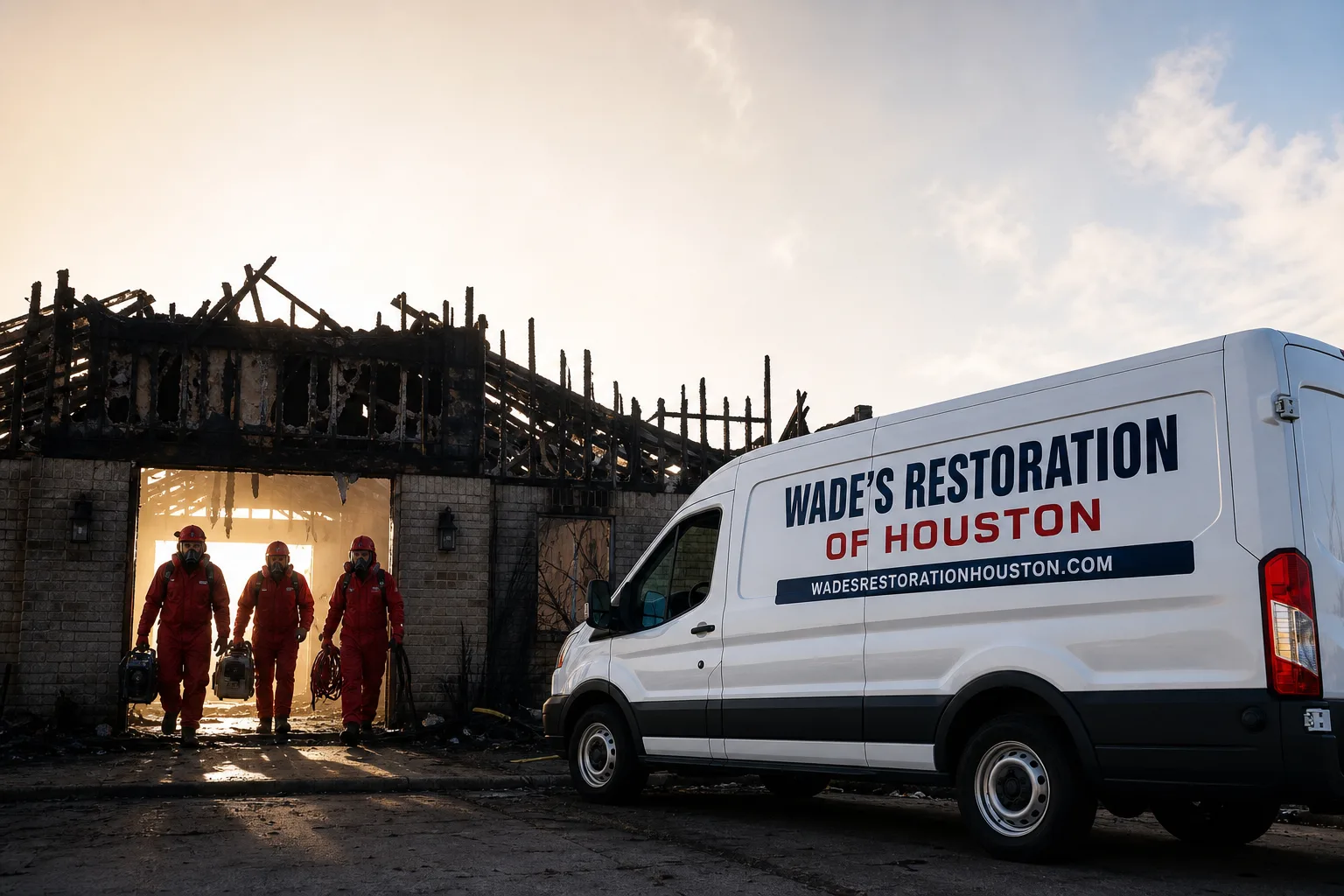
Fast, Reliable Storm & Disaster Restoration Across Freeport
Storm damage in Freeport hits different than it does ten miles inland. When the Brazos River crests while Gulf surge pushes in from the south, you’re not dealing with one flood, you’re dealing with two that meet in your living room. Wade’s Restoration gets to Freeport homes fast, usually with extraction running within the hour of your call. We’ve worked the pier-and-beam houses off Velasco Boulevard, the older stock near Old Velasco, and everything in 77541 and 77542. Call (888) 534-8116 and you’ll get a live person, not a queue.
Why Wade’s Restoration of Houston Is Freeport’s Preferred Storm & Disaster Restoration Company
Wade Ferris founded this company in 2007, and he still answers his own phone. That matters in Freeport, where homeowners have been burned by national outfits that quote one number on the phone and a different one at the door. Wade publishes his address and license number. You can find him. You’ll run into him at the hardware store. That’s the accountability that keeps him honest.
Freeport customers call us because we understand what this town deals with. The dual flood threat, the humidity that never quits, the older homes on pier-and-beam foundations that hold water under the floor for days after the surface looks dry. Our crews carry Dri-Eaz LGR dehumidifiers, Injectidry floor drying mats, and Phoenix air movers. The technicians who show up are background-checked, uniformed, and they log moisture readings every single day. At the end of the job, you get the full log. Almost nobody in this trade hands over that kind of documentation.
Wade deals with your insurance adjuster directly. You’re not stuck relaying messages between two parties who never seem to talk. That alone is worth the call.
Our Storm & Disaster Restoration Services in Freeport
Here’s what we actually do when a Freeport storm leaves your house hurting. No vague promises, just the work.
Emergency Board-Up
When wind takes out a window on West 2nd Street or a tree limb goes through a wall off Old Velasco, your house is open to weather, animals, and people who shouldn’t be there. We board up everything as soon as we can get there. Same call, no waiting days for a crew. Board-up in Freeport typically runs $450 to $900 depending on how many openings and whether we’re securing first-floor or second-story access. We don’t wait for the adjuster to approve board-up. We secure the home, we document everything with photos, and we deal with insurance after.
Roof Tarping
A tarp over damaged roofing keeps the next rain from turning a small repair into a full gut job. We tarp in Freeport constantly after spring storms and hurricane season. Expect to pay $350 to $700 for a standard tarp job on the older ranch and bungalow roofs common here. Taller two-story homes near the chemical plant corridor run higher because of access and safety harness requirements. Tarps last 90 days, which buys you time to file and get the adjuster out.
Flood Damage Restoration
This is the big one for Freeport. When Brazos floodwater meets Gulf surge, you get Category 3 black water that carries both sewage and industrial runoff from the Dow complex. That’s not a standard dry-out. That’s a decontamination project. We cut out saturated drywall, pull carpet and pad, treat framing with antimicrobial, and run drying equipment until the moisture log says the structure is actually dry, not just dry-looking. Typical flood restoration in Freeport runs $3,500 to $12,000 depending on square footage and how deep the water sat. Homes on pier-and-beam with original wood subfloors run higher because that wood holds water like a sponge.
Storm Damage Cleanup
Debris removal, downed limb clearing, water extraction, content triage. After a Freeport storm, the yard is full of things that used to be somewhere else. We handle it. Storm cleanup runs $800 to $2,500 for a typical single-story home, more if there’s significant structural debris or hazardous material mixed in.
What happens when you call
- 1
A real person answersNo phone trees - you reach a local pro.
- 2
You get an upfront price rangeHonest numbers before anyone is dispatched.
- 3
A background-checked tech heads outLicensed & insured, dispatched right away.
- 4
You approve before work beginsNothing starts until you say go.
Trusted Brands We Service in Freeport
We run professional-grade equipment from Dri-Eaz, Phoenix, and Injectidry, not rental-store machines. Our team holds IICRC certifications, and Wade is affiliated with RIA and recognized by the IFA. Why does that matter to a Freeport homeowner? Because when you’re fighting floodwater that carried industrial runoff through your pier-and-beam subfloor, the wrong equipment leaves moisture behind and mold follows. We bring the right gear, set it up correctly, and document the drying curve. If you’ve got an older Freeport house with original plaster walls or non-pressure-treated framing, we’ve seen what works and what doesn’t.
Common Storm & Disaster Restoration Problems We See in Freeport Homes
- Dual-source flooding that traps water for days. The Brazos crests upstream while Gulf surge pushes from the south. Water backs in from both directions, and it has nowhere to go. Homes on the lowest streets in Freeport hold standing water longer than any single-source flood would produce, which starts the mold clock early and forces more aggressive drying.
- Pier-and-beam foundations with wet, rotting subfloors. Most Freeport houses built for Dow Chemical workers in the 1940s through 1960s sit on pier-and-beam. Water gets under the house, wicks into the original pine subfloor, and stays trapped between the joists. It looks dry upstairs, but underneath there’s a vapor trap brewing rot and mold.
- Chemical contamination that standard sewage protocols miss. Floodwater that passes through the Dow Freeport corridor can carry phenols and petrochemical residue. Standard Category 3 treatment handles sewage. It doesn’t handle industrial runoff. Without testing, that residue stays in porous plaster walls and requires a second full decontamination pass.
- Humidity that never gives the house a break. Freeport’s relative humidity sits above 80% most of the year. Even a minor leak or a few inches of surge means secondary moisture damage and mold colonization within 24 to 48 hours. Quick action isn’t optional here, it’s the difference between drying a house and gutting it.
Pricing for Storm & Disaster Restoration in Freeport, TX
We Also Serve Cities Near Freeport
Our Storm & Disaster Restoration crews work throughout the Brazosport area. If you’re in Clute, Lake Jackson, Angleton, or Alvin, we get to you just as fast. But the flood dynamics change city by city. What happens in Freeport with the Brazos and the Gulf combining doesn’t happen the same way in Lake Jackson or Angleton, and that changes how we dry a house. Experience on Freeport jobs taught us what works here, and we apply that everywhere we go.
Serving Freeport, TX - Our Local Coverage Area
We’re based in the Freeport area and know this community well. Use the map below to see our service coverage - if you’re nearby, we can almost certainly help.
FAQs - Storm & Disaster Restoration in Freeport
How do I know if the floodwater in my Freeport home came from the Brazos River, the Gulf surge, or both?
The short answer is you usually can’t tell just by looking, but we can. Brazos river water carries heavy silt and agricultural runoff. Gulf surge carries salt and marine debris. When both hit, you get brackish water with a mix of organic material, salt, and often industrial contaminants from the Dow corridor. We test the water and the materials it soaked. The distinction matters because river water, surge water, and mixed water each leave different residues that require different decontamination approaches. The wrong assumption means a second cleanup pass later, after mold or chemical smell sets in. Call (888) 534-8116 and we’ll assess what actually happened in your house.
Why do Freeport homes on pier-and-beam foundations need a different drying setup after a storm than slab homes in Lake Jackson?
Pier-and-beam homes in Freeport have a crawlspace under the floor, which means water gets under the house and wicks up into the subfloor and joists. Slab homes in Lake Jackson don’t have that problem because the concrete blocks ground moisture. If you use a standard closed-cell drying setup designed for slab construction on a pier-and-beam Freeport house, you dry the surface but leave the vapor trap under the original wood subfloor. That hidden moisture rots the floor from underneath and breeds mold inside the joist bays. We use Injectidry floor mats and Dri-Eaz LGR dehumidifiers positioned beneath the joists, not just in the living space, so the entire floor system dries. Most restoration outfits don’t bother with this step.
My Freeport house got only a few inches of Hurricane Harvey surge, but the drywall smells musty two weeks later. What happened?
A few inches of surge doesn’t stay a few inches in Freeport. The water gets behind the baseboards, wicks up the drywall, and settles under the floor. With Freeport’s humidity above 80% year-round, that trapped moisture has no way to evaporate on its own. Within 48 hours, mold is already growing, even if you can’t see it or smell it yet. Two weeks later, the musty smell is mold that’s been feeding on damp drywall and subfloor. What happened is the structure was never actually dried, only the surface was. The fix is cutting out the affected drywall and insulation, treating the framing with antimicrobial, and running professional drying equipment until the moisture log says the interior of the wall cavity is dry. Call (888) 534-8116 and we’ll do exactly that.
Do I need to test my Freeport floodwater for chemicals, or is standard Category 3 sewage treatment enough?
If you’re in Freeport and the water moved through areas adjacent to the Dow complex or carried storm drain overflow from industrial areas, yes, you should test. Standard Category 3 treatment handles sewage and river-borne bacteria. It does not handle phenols, petrochemical residue, or other industrial runoff. Those contaminants soak into porous materials like plaster walls and wood subfloors, and if you skip testing, you end up with chemical residue that standard protocols miss. That means a second full decontamination pass later, after the smell or the staining shows up. Testing costs a few hundred dollars. Skipping it can cost thousands and leave your house unhealthy. We’ll recommend testing when the conditions call for it, and we’ll work with your adjuster to cover it.
How soon after a storm should I call for emergency board-up in the Old Velasco area?
As soon as the storm has passed and it’s safe to be outside. Old Velasco sits lower and closer to the river mouth than most of Freeport, which means wind damage is compounded by water exposure. An open window or a hole in the roof becomes a mold problem within 24 to 48 hours in Freeport’s humidity. We prioritize board-up calls and get to Old Velasco homes as fast as the roads allow after a storm, often within a couple of hours of the call. The sooner the opening is sealed, the less damage you’re facing. We document everything with photos for your insurance claim before we touch anything. Call (888) 534-8116 and Wade will head out himself.
Contact Wade’s Restoration of Houston
If your Freeport home just took a hit, don’t wait. Every hour matters when floodwater is soaking your subfloor or wind has opened your house to the weather. Wade Ferris answers his own phone, day or night. He’ll tell you straight what you’re dealing with and what it’ll cost, and then he’ll show up. Call (888) 534-8116 for a free estimate. No trip charge inside our own county. No pressure, just straight answers.
Written by Wade Ferris, Owner at Wade’s Restoration of Houston, serving Freeport since 2007.