
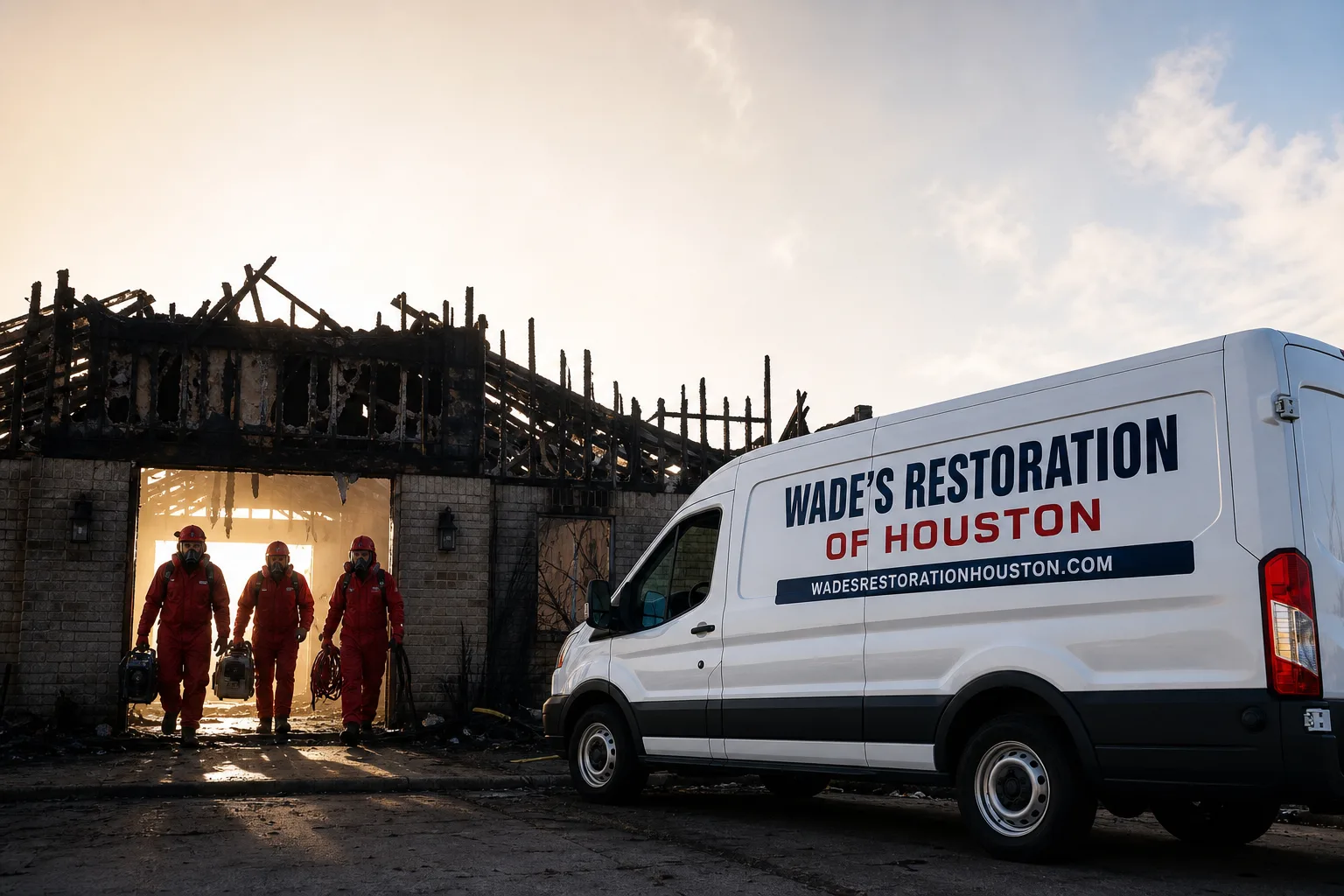
Fast, Reliable Storm & Disaster Restoration Across Channelview
Storm and disaster restoration in Channelview means treating floodwater as contaminated by default. That’s not a scare tactic. It’s a protocol distinction driven by the Ship Channel petrochemical corridor that borders residential streets here. A Category 3 flood response in 77530 starts before fans ever go down: screening for hydrocarbons, documenting everything, and moving fast because 80-95% humidity turns damp Sheetrock into a mold farm inside 48 hours. Call Wade Ferris at (888) 534-8116. He answers his own phone.
Why Wade’s Restoration of Houston Is Channelview’s Preferred Storm & Disaster Restoration Company
Wade Ferris has been in and out of Channelview homes since 2007, and he’s the one who shows up, not a sales rep from a call center three states away. That matters here more than in most places. Channelview jobs are different. A house off Sheldon Road built in 1963 on a pier-and-beam foundation presents problems a tract home in Katy never will. Wade knows those crawlspaces, knows how original oak subfloors wick water, and knows which local streets flood first when a squall stalls over the Ship Channel.
Crews coordinate from the Houston office, but they serve Channelview on the ground, same-day. When you call at 2 a.m. with water rising through your vents, you’ll get Wade or someone who works directly under him. No answering service. No voicemail. He’ll be on the road with extraction equipment before most national outfits have finished the intake questionnaire.
Channelview review mentions point to the same things: the owner shows up, he deals with the adjuster directly, and he hands over a full moisture log when the job’s done. Almost nobody else in the trade does that last part. Wade does. Every single day of a dryout, readings get logged. You see exactly what he sees.
Our Storm & Disaster Restoration Services in Channelview
Our Storm & Disaster Restoration work covers the full sequence from tarping to rebuild, but in Channelview three services get used more than anything else.
Flood Damage Restoration
Flood damage restoration in Channelview starts with a blunt question: did the water come through your neighborhood, or through your back door? If it touched the ground anywhere near the Ship Channel corridor, we’re treating it as Category 3, period. That means full PPE, containment, contaminated-material removal, and industrial-grade drying with Dri-Eaz and Phoenix equipment. The 2017 Harvey event proved what prolonged inundation does to this ZIP code. Homes that got three feet of water inside now have original subfloors that never truly dried. We go after that hidden moisture with Injectidry systems that pull water from hardwood and oak subfloors without ripping everything out first.
Storm Damage Cleanup
Storm damage cleanup in Channelview often means dealing with wind-driven rain that found the gap in a 1960s jalousie window or a corrugated porch roof that gave way. We clear debris, document damage for your carrier, and get tarps up before the next band of weather comes through. Debris removal is part of this too, including saturated insulation, ruined drywall, and the plywood sheets covering a broken sliding door. We haul what the storm left behind, and we take the daily moisture readings that tell you whether things are actually drying or just looking dry.
Emergency Board-Up
When a Channelview storm blows out a window or a branch comes through an aluminum-frame sliding door, the house is open to more rain, animals, and nobody you want inside. Emergency board-up stops the bleeding. Wade’s crew gets plywood over the openings fast, secures doors that won’t latch, and gives you something to show the adjuster other than a rain-soaked living room. Board-up isn’t the glamorous part of restoration. It’s the part that prevents a $3,000 window replacement from becoming a $14,000 wall-and-floor gut.
Roof Tarping
Roof tarping on Channelview’s older roof lines, especially the shallow-pitch 1950s bungalows around Bayou Drive and Dell Dale Avenue, has to account for brittle decking and original felt that tears under foot. We tarp to hold until a real roof crew can get there, but we also check whether water already migrated into the attic insulation. A tarp that keeps new rain out doesn’t do a thing for the water already soaking through your ceiling joists. That’s the difference between a temporary fix and a documented, dried-out one.
What happens when you call
- 1
A real person answersNo phone trees - you reach a local pro.
- 2
You get an upfront price rangeHonest numbers before anyone is dispatched.
- 3
A background-checked tech heads outLicensed & insured, dispatched right away.
- 4
You approve before work beginsNothing starts until you say go.
Trusted Brands We Service in Channelview
Most Channelview storm work involves equipment the homeowner never thinks about until it fails: Dri-Eaz dehumidifiers, Phoenix air movers, Injectidry hardwood drying mats, B-Air filtration units. We service all of them and we stock common parts so we’re not waiting on a distributor in Dallas while your subfloor stays wet. Our techs carry IICRC certifications, and our processes align with RIA and IFA guidance. The gear matters, but the person reading the moisture meter matters more.
Common Storm & Disaster Restoration Problems We See in Channelview Homes
- Category 3 floodwater in the 77530 corridor. Storm runoff near the Ship Channel can carry petrochemical residue that most residential restoration checklists never mention. Skipping industrial-hygiene screening before demolition means you might be releasing benzene from saturated materials into your living space.
- Saturated pier-and-beam crawlspaces. Homes built in the 1950s through 1970s in Channelview often sit on piers with unconditioned crawlspaces and fiberglass batts under the floor. We see fans running upstairs while the subfloor stays at 28% moisture content underneath, feeding mold within 48 to 72 hours in the local humidity.
- Original galvanized plumbing that re-floods the same wall cavity. Storm restoration isn’t done if old pipes inside a wall are still weeping. We have seen post-storm dryouts where the same baseboard swelled twice because nobody checked the galvanized supply lines behind the wet drywall.
- Single-pane jalousie and aluminum-frame window leaks. The older windows common in Channelview’s petrochemical-era housing stock don’t seal against wind-driven rain. Water runs down the interior wall, collects behind the sill, and sits there until the drywall starts to crumble or the subfloor begins to cup.
Pricing for Storm & Disaster Restoration in Channelview, TX
We Also Serve Cities Near Channelview
Wade’s Restoration runs the same Category 3 protocols and same equipment in Cloverleaf, Jacinto City, Highlands, and Galena Park. If you’re just outside Channelview proper, the response time doesn’t change much. Wade coordinates from the Houston office and keeps crews staged where the flood risk is worst, which on this side of Harris County means the Ship Channel corridor.
Serving Channelview, TX - Our Local Coverage Area
We’re based in the Channelview area and know this community well. Use the map below to see our service coverage - if you’re nearby, we can almost certainly help.
FAQs - Storm & Disaster Restoration in Channelview
No. Clean rainwater that enters through a roof leak or a broken window without touching the ground can be treated as Category 1 or 2. The Category 3 default applies when water has touched the ground in Channelview’s 77530, because storm runoff near the Ship Channel can co-mingle with hydrocarbon residue, and we don’t guess about that. Wade’s crew tests standing water before deciding protocols. Call (888) 534-8116 if you’re unsure which scenario you have.
In Channelview’s sustained 80-95% relative humidity, mold colonies can reach actionable levels within 48 to 72 hours of water intrusion. That timeline compresses to as little as 36 hours if the intrusion soaked fiberglass batts in an unconditioned crawlspace. Speed is the difference between drying and gutting. If water has been inside for more than a day, call (888) 534-8116 and get a moisture assessment before the colony gets a foothold.
For any floodwater intrusion in Channelview that touched the ground, yes, we recommend an industrial hygienist before demolition or dryout. On a 1960s pier-and-beam home off Sheldon Road, we brought in a hygienist who detected trace benzene in standing water after a squall. That changed the job from a standard dryout to full containment. Most restoration companies skip this step. In 77530, skipping it can put your family’s health at risk and complicate your insurance claim. We arrange the testing and coordinate with your adjuster directly.
In our experience, the usual culprits are original galvanized supply lines weeping inside the wall, failed jalousie window seals, or roof flashing that separates at the fascia on older shallow-pitch roofs. You dry the wall cavity, repair the visible damage, and the next storm re-wets the same spot because the source was never fixed. Wade’s crew traces the water back to where it enters, not just where it pools. Call (888) 534-8116 for a written scope that covers the source, not just the stain.
It depends on how long the oak was saturated and whether the water was Category 3. Solid 3/4-inch oak subfloor that got wet for less than 48 hours can often be dried in place with Injectidry systems without losing it. If the water sat longer, or if hydrocarbon contamination is present, replacement is the safer call. Wade will give you an honest answer based on moisture readings and the hygienist’s data, not on what’s easier to bill. Call (888) 534-8116 for a free estimate.
If you’re dealing with storm damage, floodwater, or a roof that’s open to the sky in Channelview, call Wade’s Restoration at (888) 534-8116. Wade answers. He’ll tell you straight what you need and what you don’t need, and he’ll put it in writing before a single fan gets plugged in.
Written by Wade Ferris, Owner at Wade’s Restoration of Houston, serving Channelview since 2007.