
How to Choose the Right Damage Restoration Company in Houston
There are over 200 damage restoration companies licensed to operate in the Houston metro. After a major weather event, out-of-state companies flood in and that number effectively doubles. The certifications and Google reviews look the same, so here’s how to find the one that will still answer your call after the equipment is gone.
The short answer: choose the company whose owner lives in the Houston area, puts his name and address on the paperwork, and has a reason to see you at the grocery store next month. Accountability is the thing you’re actually buying. If you’d rather skip the research and talk to someone who fits that description, call (888) 534-8116 and ask for Wade.
The Saturday Accountability Test
Before you sign anything with a restoration company in Houston, run this test: ask where the owner lives. Not where the office is. Where the person whose name is on the contract sleeps at night.
Here’s why it matters. National franchise operators in Houston rotate project managers every few months. The crew that tears out your drywall in March is not the team you’ll reach in August when the musty smell comes back. They’re on a plane, or they’ve been reassigned, or the franchise changed hands. The phone number on the invoice rings a call center in another state.
A local owner in Houston has a different calculation running. He runs into you at the hardware store. His kids go to school with your neighbor’s kids. If his work fails, he hears about it not in a quarterly review but at the gas pump. That’s the oldest accountability mechanism there is, and it works better than any warranty language.
Ask directly: “Where do you live?” If the answer is vague, or the person you’re talking to doesn’t know, move on. At Wade’s Restoration of Houston, the answer to that question is published. Wade Ferris’s name is on the truck, his address is on the contract, and he answers his own phone at midnight. That’s not marketing. That’s the whole business model.
Certification: The Company Card vs. The Tech’s Card
Here’s a trick that catches more Houston homeowners off guard than any other in this industry. A restoration company can be IICRC-certified. That doesn’t mean the person standing in your living room is.
The IICRC, RIA, and IFA set the standards for water damage restoration, mold remediation, and fire damage work. A company earns certification by employing certified people. But when the phone rings after a flood, that company might send whoever is available. The guy pulling your baseboards could be on his third week.
So ask the question this way: “Can I see the card for the specific technician who will be in my home?” Not the company’s wall certificate. The tech’s card, with his name and his number on it.
If the answer is anything other than “sure, here it is,” that’s a red flag. Every person Wade sends to a Houston job has credentials you can verify. Background-checked, uniformed, and answerable by name. You should know exactly who is in your house and what they’re qualified to do before the first piece of equipment comes off the truck.
What a Written Scope of Work Should Actually Contain
In a competitive market like Houston, the cheapest quote often wins. And that’s exactly where homeowners get hurt. A scope of work isn’t a price tag. It’s a promise written down. If the promise is vague, the price doesn’t matter.
Before you sign anything, the scope should include three things, in writing, with real numbers:
- Line items. Not “drying services.” Specific rooms, specific surfaces, specific square footage. If it says “kitchen area,” ask them to define the boundary. A written scope from a Houston restoration company should read like a map of your house, not a summary.
- Drying goals in measurable moisture readings. This is the one almost nobody asks for, and it’s the one that matters most. The drying goal should say something like “wood subfloor in living room reaches 12% moisture content or below, measured daily.” At Wade’s Restoration of Houston, we take moisture readings every single day and hand you the full log when the job is done. Almost nobody in the trade does that. It’s the difference between “looks dry” and “is dry.”
- The done condition. What does finished mean? If the scope says “remove and replace drywall,” does that include paint? Trim? Final cleanup? If it doesn’t say, you’ll find out when the invoice arrives.
Get it in writing before work starts. If a company won’t put the done condition on paper, that’s your cue to call someone else.
The Adjuster Question Nobody Thinks to Ask
Water, fire, and mold claims in Houston almost always involve an insurance adjuster. And most homeowners spend weeks stuck in the middle, relaying information between the restoration company and the insurance company. The contractor says one thing. The adjuster says another. You’re the one making the phone calls.
Ask this before you hire anyone: “Will you talk directly to my adjuster?”
Follow up with: “Will the moisture logs and photos be in a format the adjuster accepts?”
If the company hands you a stack of papers at the end and says “give these to your insurance,” that’s a problem. That means you’re the project manager now, and you’ll be the one fighting if the claim gets denied.
A company that communicates directly with your adjuster, provides documentation the adjuster can actually use, and keeps you out of the middle is worth more than any price discount. It’s the difference between a stressful month and a claim that closes.
The Low-Bid Trap in Houston’s Post-Storm Market
After a storm in Houston, competition for restoration work gets fierce. Out-of-state companies roll in, undercut local pricing, and grab jobs on volume. It can feel like a deal. It’s usually a trap.
Here’s how it works. The low bidder scopes the job for what you can see. Wet drywall, standing water, visible mold. But water doesn’t stay where you can see it. It moves through wall cavities, under flooring, into the sill plates behind your baseboards. If the scope doesn’t include hidden cavity drying or mold prevention treatment, that work doesn’t get done. Until it does.
Six weeks later, the smell comes back. You call the company. They’re gone, or they tell you the original scope didn’t cover “mold remediation,” and here’s the second invoice for four times the amount.
Ask any bidder this: “Does this scope include wall cavity drying and mold prevention treatment for areas behind the drywall?” If the answer is no, or if they tell you they’ll “check for that later,” you’re looking at a second invoice waiting to happen.
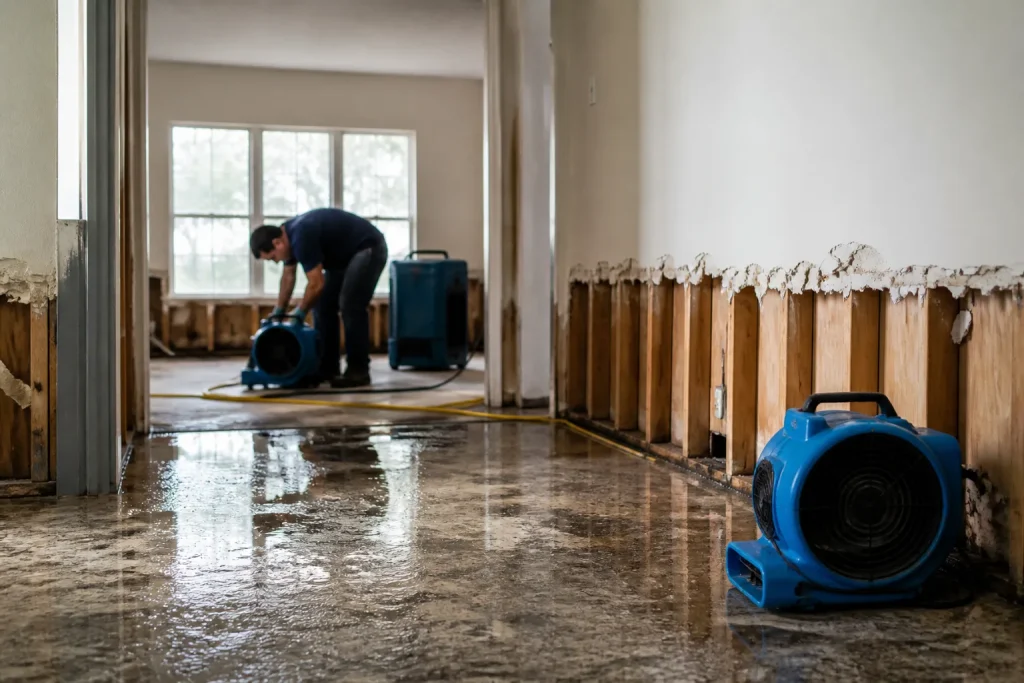
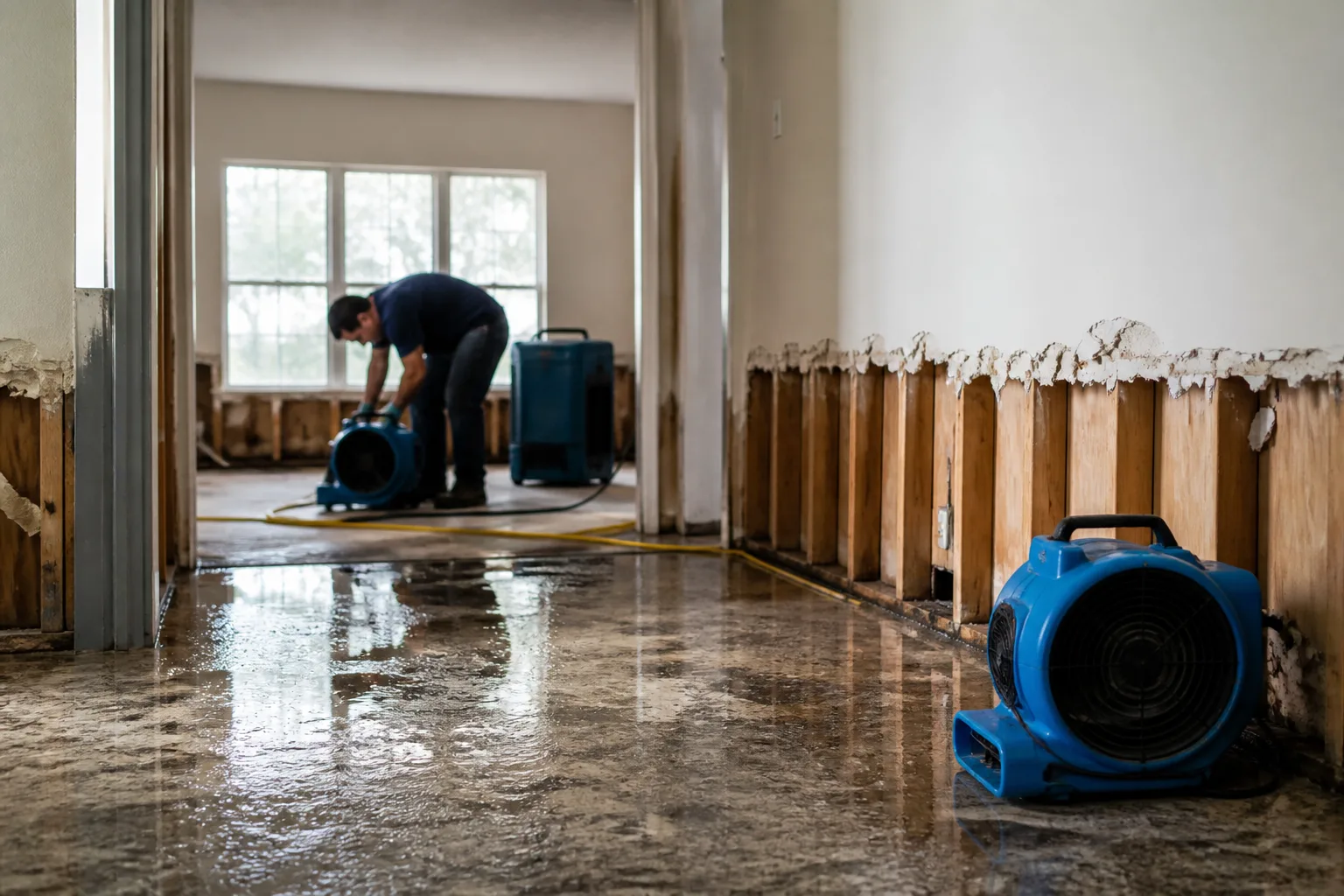
At Wade’s Restoration of Houston, we use professional-grade equipment from Phoenix, XPOWER, and B-Air, and we set drying goals you can see in the daily readings. The scope covers what needs to happen, not just what’s visible when you sign.
When to Call a Pro
Here’s the honest part. Some water damage you can handle yourself with a mop and a fan. A small spill on a tile floor, a leak you caught immediately, a section of drywall the size of a towel. If it’s dry in a day and the smell is gone, you’re probably fine.
But if any of these apply, call someone who does this every day:
- Water touched drywall, insulation, or subfloor. Those materials wick moisture and hide it. By the time you smell it, mold has already started.
- The water isn’t clean. Sewage, flood water, or anything that sat for more than a day carries contaminants you don’t want in your air.
- You see water staining on the ceiling below a wet area. That means water is moving through the structure.
- You’re filing an insurance claim. Adjusters want third-party documentation, and they’ll trust a professional’s moisture log more than your photos.
If you’re in Houston and any of that sounds familiar, call (888) 534-8116. Wade heads out himself or sends his crew, and you’ll know before anyone starts what the plan is and what it will cost.
The Bottom Line
Choosing a damage restoration company in Houston comes down to one question: will the owner have to look you in the eye six months from now? Ask where the owner lives. Ask for the specific technician’s certification card. Get the scope in writing with drying goals in measurable numbers. Ask who talks to your adjuster. And don’t fall for the low bid that excludes the work you can’t see.
If you’re in Houston and need help, Wade’s Restoration of Houston offers free estimates. Call (888) 534-8116 and you’ll get a real person, on the phone, who lives here and puts his name on the work. If you’d rather see it first, the Wade’s Restoration of Houston home page has the details. And if you’re dealing with water right now, start with Water Damage Restoration in Houston. Mold problems have their own page at Mold Remediation in Houston, and fire or smoke damage is covered at Fire & Smoke Damage Restoration in Houston.
Frequently Asked Questions
How do I know if a Houston restoration company is actually local?
Ask where the owner lives. Not the office address. The person whose name is on the contract. If the answer is vague or the person you’re talking to doesn’t know, it’s likely a franchise or an out-of-state operation. A truly local Houston company has an owner you could run into at the hardware store. That’s your accountability guarantee.
What’s the difference between a company certification and a technician certification?
A company can be IICRC-certified while sending uncertified workers to your home. Always ask to see the specific technician’s card, not the company’s wall certificate. The person doing the actual work should have their own credentials, their own name, and their own accountability. If the company won’t show you the tech’s card, call someone else.
Will my insurance cover damage restoration in Houston?
Most homeowner policies cover sudden and accidental water damage, fire damage, and often mold remediation when it results from a covered event. But the claims process depends heavily on documentation. A restoration company that talks directly to your adjuster and provides moisture logs and photos in a format the adjuster accepts is far more likely to get your claim approved. Ask about adjuster communication before you sign.
Why is the cheapest Houston restoration quote usually the most expensive in the end?
Low bidders scope for what’s visible. Water hides in wall cavities, under flooring, and behind baseboards. If the scope doesn’t include hidden cavity drying and mold prevention, that work gets skipped. Then it shows up weeks later as a second invoice for remediation the first crew didn’t do. Get the full scope in writing, including drying goals and the done condition, before work starts.
Written by Wade Ferris, Owner at Wade’s Restoration of Houston, serving Houston since 2007.
Need Damage Restoration Help?
Call Wade's Restoration of Houston - licensed & insured, here with fast after-hours help in Houston.
(888) 534-8116