
Emergency Water Damage Restoration Near Me: What Houston Homeowners Should Do First
Searching “emergency water damage restoration near me” is the fourth thing you should do, not the first. The homeowners who come out of Houston flood events with the cleanest insurance claims and the least mold are the ones who did three specific things before they ever called a contractor. If you’ve already got water where it should not be, call (888) 534-8116 right now and we’ll walk you through it while Wade heads your way. Otherwise, here’s the order that actually matters.
In the past fifteen years of pulling soaked drywall and carpet out of Houston homes, we’ve watched the same pattern repeat after every storm. The family that starts a fan and takes pictures before calling around is the family still living in their house six months later. The family that burns the first hour scrolling reviews while water climbs the baseboards is the family sleeping in a hotel with a Category 2 claim and a mold estimate that makes them sick. The first sixty minutes matter more than which company shows up.
Do These Three Things Before You Search “Emergency Water Damage Restoration Near Me”
Here’s the sequence we tell every Houston homeowner who calls us mid-flood. It works whether you’re dealing with a burst pipe in Katy, a sump pump failure in Cypress, or storm surge pushing under the doors in Meyerland.
- Kill power to the affected circuits at the breaker. Water and electricity kill faster than water alone. Don’t wade into standing water to reach an outlet. Flip the breaker first, from a dry spot if you can. If the panel is behind water, call the utility company and stay out of that room.
- Stop the water source, or get off that floor if it’s rising. If it’s a burst supply line, turn the valve. If it’s storm water still coming in, you can’t stop it. Get yourself and any people or pets upstairs or out. Furniture isn’t worth a slip on wet concrete.
- Take a timestamped video walkthrough before you move anything. Your phone’s camera app stamps the time and date. Walk every affected room, open every closet, get down at floor level and film standing water. This video is the single most useful document you’ll hand a claims adjuster. It proves what was wet, when, and what it looked like before you started moving things. We’ve watched this one habit flip a disputed claim into a settled one more times than we can count.
After those three things, then you start calling. If you’re in Houston, that call can be to us at (888) 534-8116. We answer live, every hour, and Wade himself has been known to pick up at 2 a.m. with extraction equipment already in the truck.
Why Houston’s Heat Makes Water Damage Different Here
An HVAC condenser coil freezes over in February, thaws into a kitchen ceiling, and a homeowner in Minnesota gets maybe three days before mold starts. Here in Houston, you get hours. This is the part that national restoration chains don’t put in their marketing, because their call-center scripts were written for Chicago and Phoenix.
Houston’s combination of heat and humidity, every month except maybe January, turns a wet carpet into a biological event while you’re still looking for a plumber’s number. Mold spores that would colonize in seventy-two hours in a dry climate will start germinating inside six hours on a Houston afternoon when the outside air is ninety degrees and the inside of your wall cavity is ninety-five and saturated. That’s not an estimate on our part. That’s IICRC-standard science we apply on every water damage job we walk.
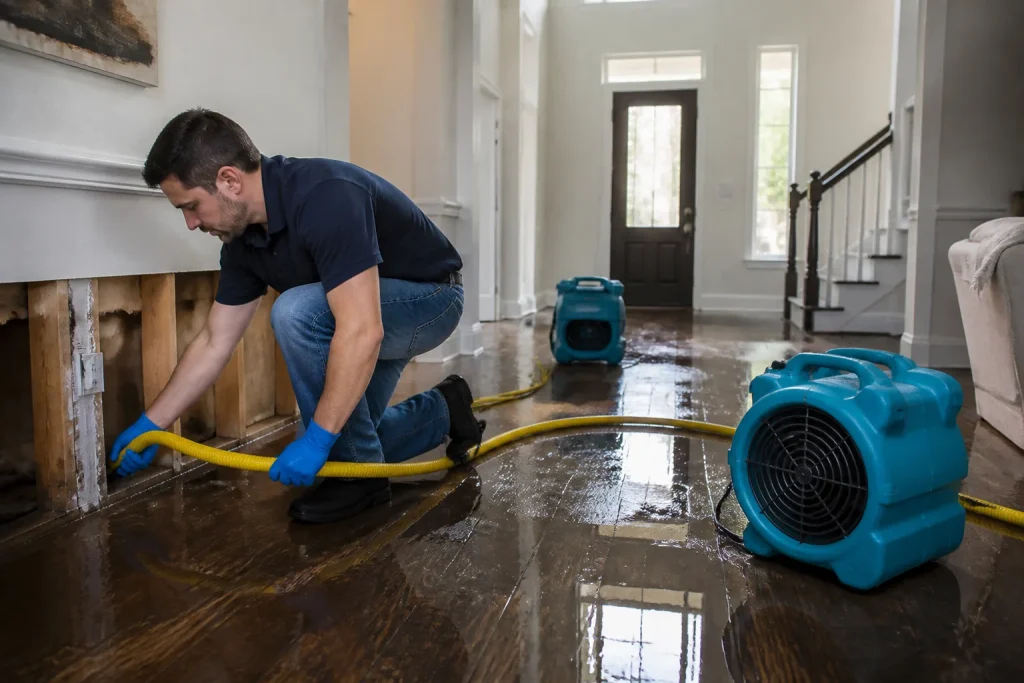
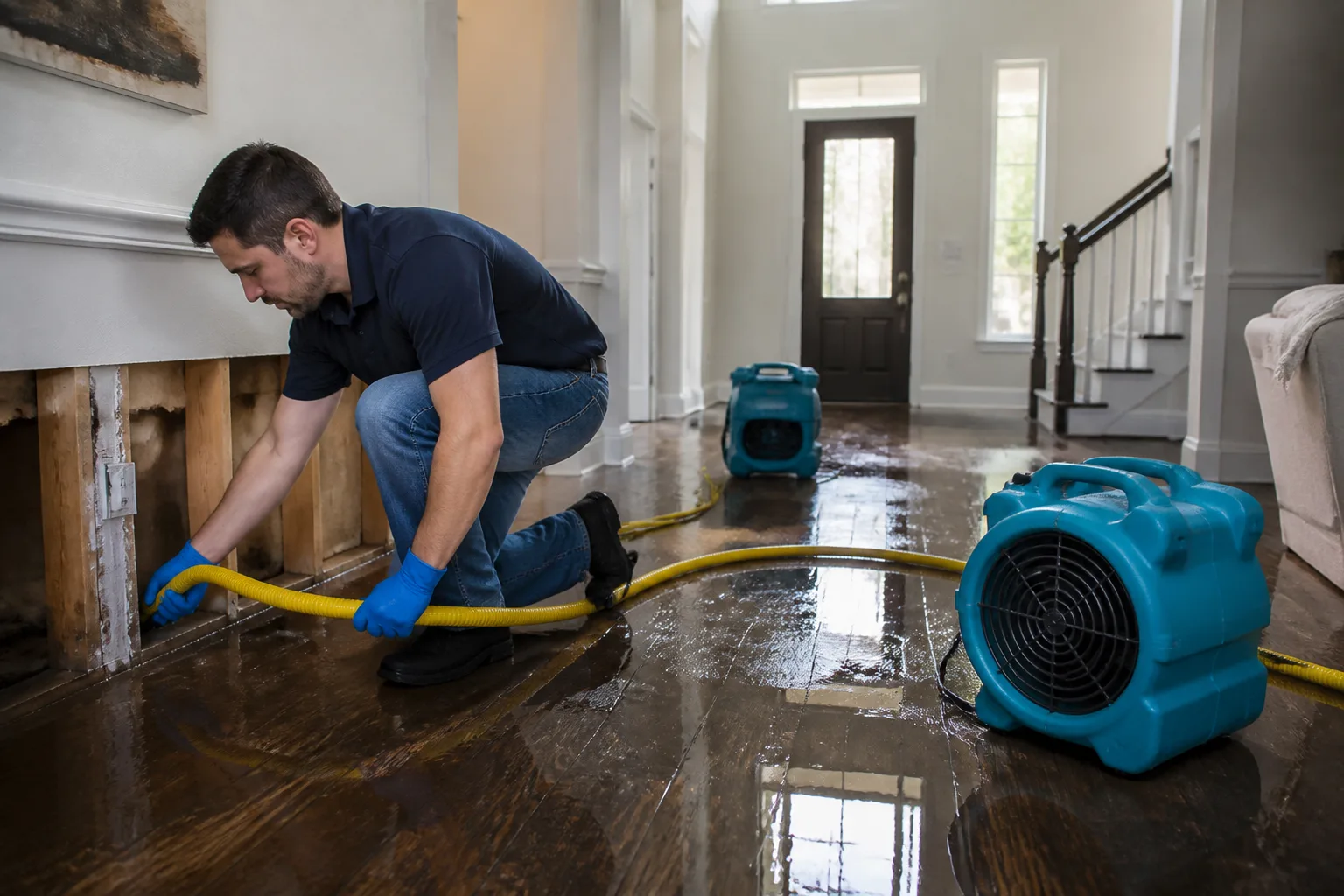
What this means practically: if a pipe lets go at 2 p.m. in a house without climate control, and you wait until 8 a.m. the next day to start airflow, you’ve already lost the race on mold prevention. You can still clean it up, but it’s a remediation job now, not just extraction and drying. The fix for this is airflow and dehumidification started the same day. A box fan from the hardware store aimed at wet drywall is better than nothing, but professional air movers from B-Air and XPOWER move the kind of cubic feet per minute that actually dries a wall cavity before biology wins. We run exactly that equipment and we take moisture readings every day until the numbers prove it’s dry, then we hand you the log.
Category 1 vs Category 2: What Waiting Does to Your Claim
Water damage starts as one thing and becomes another if you don’t act. The insurance industry classifies water in three categories. A homeowner who understands this has leverage. A homeowner who doesn’t gets a smaller check.
Category 1 is clean water, meaning water from a supply line, a faucet left running, a cracked toilet tank. It’s safe at first. Category 2 is significantly contaminated water, meaning it’s sat long enough to support bacterial growth, or it’s mixed with something unclean. Category 3 is the bad one, sewage and flood water, and that’s a separate conversation.
Here’s the part that surprises people: Category 1 water doesn’t stay Category 1 when it sits in a Houston garage in August. Standing water that starts clean picks up whatever it touches, and in a warm house it starts growing things quickly. Many policies cover Category 1 clean-up at one rate and Category 2 at another, and an adjuster walking in three days after the event is professionally obliged to document what he sees, not what it was on day one.
Your timestamped video from that first hour is your proof, but the thing that protects the claim even more is getting extraction going before the water reclassifies. If you call us the day it happens, we’re running extractors that same day, and the adjuster sees a wet house that’s already getting dry, not a swamp that sat for a weekend. That first phone call, made early, is the cheapest insurance you’ll ever buy. Call (888) 534-8116 before you move your living room furniture.
The Houston Storm-Chaser Problem: Read Before You Sign
After every major Houston flood, the out-of-state trucks roll in. You’ll see them in the days after the event, knocking doors in Kingwood, Humble, Bellaire, anywhere water pooled. They wear matching polo shirts. They carry clipboards. And the first thing they hand you is not an estimate, it’s an Authorization to Proceed.
That single-page form is a contract, and it can transfer rights you don’t want to give away. In many cases, it assigns the restoration company the right to bill your insurance directly, often at rates your adjuster has never agreed to, and it can make the restoration company the payee on your claim funds. We’ve met homeowners in Houston who signed one of these at the door on a Tuesday and spent the next six weeks fighting with their own insurance company about what was or wasn’t approved, because the door-knocker had already sent a bill for $28,000 worth of work nobody scoped.
You don’t have to sign anything on the spot. You especially shouldn’t sign anything written by someone who knocked on your door uninvited. Here’s what to ask before anyone gets a signature:
- Are you licensed by the state of Texas, and can I see the number right now? A real restoration company has it printed on their proposal. If they fumble, that’s the end of the conversation.
- Who talks to my adjuster, you or me? If the answer is “you,” you’ll be the one relaying information between two parties who don’t want to talk to each other. Wade deals with adjusters directly. It’s not a service we sell separately, it’s just how he runs a job.
- What does your daily moisture documentation look like? If they look confused, move on. We hand every homeowner a daily moisture log, signed and dated, showing the readings from day one to day done. Almost nobody in the trade does this, and it’s the difference between “trust us, it’s dry” and “here’s the data proving it’s dry.”
Those three questions take sixty seconds, and they’ll cut through ninety percent of the operators working Houston after a storm.
What to Expect When You Call a Restoration Company in Houston
You’re standing in water, you’re stressed, and you’re making the phone call that determines how the next month of your life goes. Here’s the plain version of what should happen next.
A real company answers with a person. Not a voicemail tree, not an answering service that promises a callback. Within the next hour, someone should be on the road to you, and that first visit should include a written scope, a price, and a plan, not a handshake and a promise to “get back to you.” We answer the phone like that because Wade answers his own phone. It’s his number. It’s been his number since 2007.
Once extraction starts, the work looks like this: standing water comes out with extractors, wet material that can’t be saved gets cut and removed, and then the drying begins. In Houston’s humidity, that’s not a one-day job in most cases. Expect air movers and dehumidifiers running for three to five days, maybe longer if the water got into wall cavities. We use Dri-Eaz and Injectidry equipment because it’s what works, not because it’s what’s cheap. And someone should be checking readings daily, not setting a timer and hoping.
If you’re not sure whether you even need a pro yet, here’s the line: if water covered more than a few square feet, or it touched drywall, or it sat for more than a couple of hours, you need equipment a homeowner doesn’t own. If it’s a puddle under a sink that you caught immediately, wipe it up, run a fan, and keep an eye on it. But if you’re asking “do I need water damage restoration or can I clean this up,” and the water is still there, err toward calling. A free estimate costs nothing. Waiting costs everything. You can reach us at (888) 534-8116 and we’ll tell you honestly whether it’s a job for us or a job for a mop.
For more on what full Water Damage Restoration in Houston looks like, including what to expect from start to finish, we’ve put the whole process in writing. And if the water has already sat long enough that you’re worried about what’s growing behind the baseboards, that’s a Mold Remediation in Houston conversation, and it’s better to have it early than after the smell sets in.
Key Takeaways for Houston Homeowners
- First hour, three jobs: kill the breaker, stop the water or get out, film everything before you move it.
- Houston’s heat changes the timeline. You have hours, not days, to start airflow before mold becomes a factor.
- Clean water becomes contaminated water if it sits. That changes both your coverage and your cost.
- Never sign an Authorization to Proceed from a door-knocker. Read it, call your adjuster, ask the three questions.
- Who you call matters less than when you call. Early extraction is cheaper than late remediation, every single time.
The Bottom Line
If you take nothing else from this, take the order: breaker, water source, video, then phone. The homeowners in Houston who do those three things before they search “emergency water damage restoration near me” are the ones who end up with dry homes and settled claims. The ones who skip the video and sign the first clipboard that shows up are the ones calling us six months later for a mold problem that insurance won’t touch.
We’re Wade’s Restoration of Houston home base, locally owned since 2007, and we do everything from flooded kitchens to fire cleanup and storm damage. If you’re in Houston and you’ve got water where it shouldn’t be, call (888) 534-8116. We’ll tell you straight what you’re dealing with, and if we can’t help, we’ll tell you that too. The estimate is free, and if you’re in our county, so is the trip.
Frequently Asked Questions
If you call (888) 534-8116, you’ll get a live person, and Wade can usually have extraction running inside the hour, depending on where in the Houston area you are. We don’t use answering services. The person you’ll see at your door is the person you called.
Most Houston homeowners policies cover sudden and accidental water damage, like a burst pipe, but coverage specifics depend on your policy and how quickly you act. Your timestamped video and our daily moisture documentation are exactly what adjusters need to process a claim cleanly. Wade communicates with the adjuster directly, so you’re never stuck in the middle.
If water spread beyond a small contained area, touched drywall, or sat for more than a few hours in Houston’s heat, you need professional extraction and drying. A shop vac and a box fan can’t pull moisture from inside wall cavities, and that’s where the mold starts. Call us for a free estimate and we’ll tell you honestly what your situation calls for.
Water damage restoration is the immediate response: extraction, drying, and restoring the home. Mold remediation is what’s needed if water damage wasn’t addressed quickly, or if the water sat long enough for mold to start growing. In Houston, that window is short. If you’re already seeing discoloration or smelling must, reach out to us about Mold Remediation in Houston before it spreads further.
We handle the whole range of damage restoration, including Fire & Smoke Damage Restoration in Houston. A house fire almost always involves water damage from the firefighting, and we handle both. One call, one team, one written scope that covers the whole job.
Written by Wade Ferris, Owner at Wade’s Restoration of Houston, serving Houston since 2007.
Need Damage Restoration Help?
Call Wade's Restoration of Houston - licensed & insured, here with fast after-hours help in Houston.
(888) 534-8116