
Water Damage Restoration Cost Guide: What Houston Homeowners Pay in 2026
Water damage restoration in Houston typically runs between $1,800 and $7,500 for a single affected room in 2026, with whole-home floods ranging from $15,000 to $50,000. What you actually pay depends less on the square footage than on three things most cost guides never mention: which category of water you’re dealing with, how long the water sat before extraction started, and whether your adjuster accepts the scope without a fight. If you’re staring at standing water right now, skip the math and call (888) 534-8116, and Wade can have extraction running inside the hour.
We’ve been doing Water Damage Restoration in Houston since 2007, and the number one mistake we see homeowners make is waiting. They pull up a cost guide, see a national average like $3,200, and start calculating whether they can make it work next week. But Houston is not the national average. It sits on expansive clay soil that shrinks and swells, it floods from the top and the bottom, and the humidity alone turns a two-day drying job into a five-day one. Here’s the real breakdown.
What Water Damage Restoration Actually Costs in Houston, by Category
The insurance industry divides water into three categories, and each one carries a different price tag in Houston. The category determines how much equipment gets deployed, whether antimicrobial treatment is required, and how much material gets cut out and replaced.
Category 1: Clean Water comes from a supply line, a faucet left running, or a water heater. No sewage, no sitting contamination. In Houston, expect to pay $1,200 to $3,800 for a single room. The water is “clean” at the source, but Houston’s heat means even clean water grows bacteria within 48 hours if it isn’t extracted and dried fast.
Category 2: Gray Water means the water has been used in some way, think washing machine discharge, dishwasher overflow, or AC condensate that’s been pooling. It carries microorganisms but no solid waste. Restoration costs run $3,000 to $7,500 per room because it requires antimicrobial application, and drying standards are stricter. Padding under carpet almost always gets replaced at this level.
Category 3: Black Water includes sewage backups, rising floodwater from outside, or any water that’s been sitting long enough to grow things. This is the expensive one: $5,000 to $15,000+ per affected area. In Houston, post-storm water gets classified this way by default because stormwater carries whatever it picked up from the street. Everything porous goes, drywall gets cut above the waterline, and the entire affected space gets treated before drying equipment even turns on.
These ranges assume you catch it within the first 24 to 48 hours. After that, the numbers climb. More on that below.
Why Houston’s Numbers Don’t Match the National Average
Houston has four structural realities that inflate restoration costs beyond what a generic online calculator will tell you. If your adjuster works out of a national playbook, this is where the gap between what they price and what local labor actually costs starts to show.
The clay soil problem. Houston’s gumbo clay expands when wet and contracts when dry. Over decades, that movement puts stress on slab foundations. A slab crack isn’t water damage on its own, but it changes how quickly water migrates under your flooring. We regularly find water that traveled ten or fifteen feet from the original leak because it followed a hairline crack in the slab. That means more square footage gets affected, more equipment gets deployed, and the bill goes up.
Pier-and-beam versus slab. Older Houston homes in neighborhoods like the Heights or Garden Oaks sit on pier-and-beam foundations. When water gets under a pier-and-beam house, it pools in the crawlspace. That means pumping, extra drying time for the subfloor, and sometimes replacing insulation. A slab home in Katy or Sugar Land keeps water in the living space, which is actually faster to dry. The pier-and-beam crawlspace job usually adds $1,500 to $4,000 over an equivalent slab job.
Houston’s humidity. Restoration drying uses psychrometric science: the equipment creates a drying environment by controlling temperature, airflow, and relative humidity. When the outside air is already at 90% humidity, every unit of moisture removed from your walls fights its way back in. We run two to three times the dehumidification time in a Houston August than a restoration crew would in Dallas. That’s more days of equipment rental, more days of labor, and a higher invoice. It’s not padding. It’s physics.
Post-Harvey labor rates. Houston’s restoration labor market never fully settled after Hurricane Harvey in 2017. The demand spike pulled in out-of-state contractors at premium rates, and the rates stuck. When an adjuster prices your job using national labor tables, the discrepancy shows up fast. That’s part of why direct adjuster coordination matters more than you’d think. At Wade’s Restoration of Houston home, Wade deals with the adjuster himself so you’re not the one stuck relaying information between two sides who speak different billing languages.
Insurance, Deductibles, and the Gap Nobody Explains
The “insurance pays it all” assumption holds up about as well as a paper towel in a Houston downpour. Here’s what actually happens.
Your homeowners policy covers sudden and accidental water damage, not maintenance neglect. A burst supply line is covered. A slow leak under the sink that’s been dripping for three months is typically not. Sewage backup or floodwater from outside often requires a separate rider or flood insurance. Ask your adjuster before assuming.
Then come the deductibles and depreciation. Your policy has a deductible, typically $1,000 to $5,000 in Houston, and that’s yours to cover. Beyond that, materials are often paid on an actual cash value basis first, meaning the value of your floor or drywall minus its age. The restriction is called recoverable depreciation, and you only get it if replacement actually happens. If you take the settlement and patch the corner, you don’t get the full replacement amount.
Xactimate is the software most adjusters use to price restoration work. It spits out a number based on regional labor rates, material costs, and time estimates. But Xactimate numbers are what the insurance company thinks the job takes, not what a crew on the ground in Cypress or Pearland will actually bill. The difference between the two is the gap. A good restoration company documents everything, submits the supplement, and fights for the difference with photo logs and moisture readings. That’s the difference between you paying $2,400 out of pocket and paying $900.
Time Is the Most Expensive Variable in Houston
We tell every homeowner the same thing: water is like a houseguest that starts breaking your furniture the longer you let it stay. Here’s what the delay actually costs.
Within 24 hours: Extraction happens, drying starts, and the job is mostly about equipment. Carpet gets dried, padding might survive, drywall gets baseboard-level cuts. Single room: $1,200 to $3,500 depending on category. This is the scenario where you’re happiest with the bill.
24 to 72 hours: Materials start wicking moisture upward. Drywall soaks past the baseboards, carpet padding delaminates, and particle board under cabinets starts to swell. The affected area grows. You’re now looking at $4,000 to $9,000 per room because you’re replacing, not drying. Add Houston humidity and the drying window stretches, which means more rental days on equipment.
After visible mold appears: Once you see mold on the surface, the restoration job has a Mold Remediation in Houston component. Containment, air scrubbers, antimicrobial treatment, and disposal of porous materials. Costs run $8,000 to $20,000+ per affected area, and that’s before you start rebuilding anything. The price doesn’t climb linearly. It jumps.
One real example: we pulled one out of a garage in Cypress last month where a water heater had been leaking behind a cabinet wall for over a week. What should have been a $2,800 extraction and dry job turned into a $14,000 mold containment and rebuild because the water had time to find the baseplate and follow it into the wall cavity. The homeowner knew the heater was acting up. Nobody wants to call a plumber for a small drip. But a drip is a discount compared to what it becomes.
Decoding the Invoice Line Items
Restoration invoices look like they’re written in another language. Here’s what the common charges mean and when they’re legitimate.
Water extraction: Removing standing water with truck-mounted extractors or portable units. Should be $300 to $900 for a single room. If you see much more than that for a straightforward flooded floor, ask why.
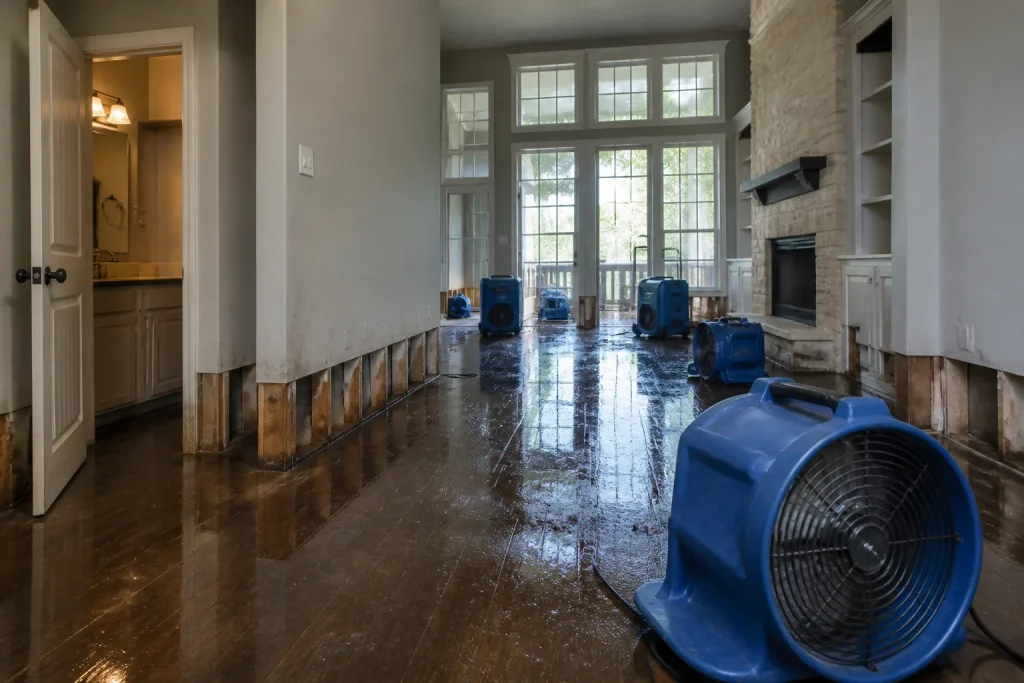
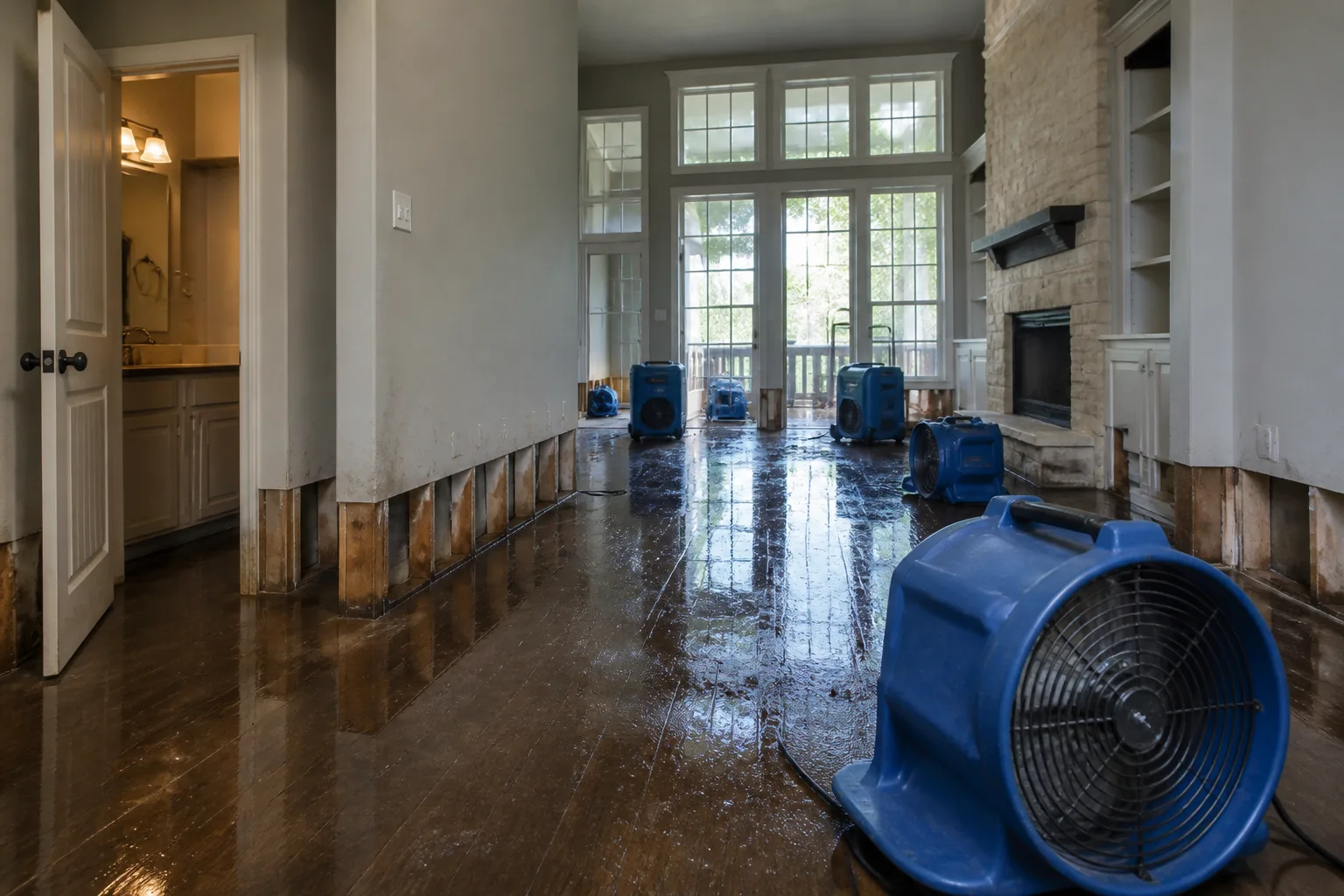
Dehumidification: Running commercial dehumidifiers and air movers to dry the structure. You’re typically charged per unit per day, and in Houston’s humidity, expect 3 to 7 days of this. Legitimate charges run $75 to $150 per day per unit. A serious room uses 4 to 8 units. That’s $300 to $1,200 per day in equipment alone. It adds up fast, and anyone quoting you a flat $500 for “drying” is either cutting corners or preparing to come back for a supplement.
Content manipulation: Moving, packing, and sometimes storing your furniture so the floor can be reached. Usually $300 to $800 per room. It’s legitimate, it’s labor, and it’s cheaper than replacing the sofa that would have soaked up two days of standing water.
Antimicrobial application: Spraying antimicrobial treatment on affected surfaces to prevent microbial growth. $200 to $600 per room for Category 1 or 2 jobs, higher for sewage work. If your water was clean and extracted within 24 hours, this should be a modest line item, not a major one.
Drywall removal and disposal: Cutting out wet drywall, bagging it, and hauling it off. Houston landfill fees and the cost of labor put this at $2 to $4 per square foot of removed drywall. When you start cutting four feet up in a 200-square-foot room, you’re replacing 600 square feet of drywall. It escalates.
If an invoice line says “equipment setup” for more than $200, or “monitoring” as a standalone charge, ask questions. Daily monitoring is part of the drying process. You shouldn’t be billed separately for someone to check a moisture reading, that is, unless they’re providing you the documentation at the end, which is a different story.
When to Call a Pro (and When You Can Handle It Yourself)
A small spill from a clean supply line that you catch within minutes can sometimes be handled with towels, a wet vac, and some fans, provided you pull up the carpet and dry the padding properly. But if any of these apply, call someone who does this every day: water has been sitting more than 24 hours, water came from outside or from a sewage line, water is touching drywall or running along baseboards, or you smell anything musty. In those situations, the cost of professional equipment is less than the cost of guessing wrong.
Related services in Houston: we also handle Fire & Smoke Damage Restoration in Houston and mold remediation, but water is the one that shows up uninvited the most.
The Bottom Line
Water damage restoration in Houston costs between $1,800 and $7,500 for a typical single-room job, but the spread comes down to category, timing, and how hard your restoration company is willing to fight the adjuster on your behalf. Cheap quotes look appealing until the invoice supplement arrives. Slow drying looks fine until the mold starts. And generic national averages don’t account for Houston clay, Houston humidity, or the post-Harvey labor market.
Here’s what matters most: act fast, document everything, and work with someone whose name is on the truck. If you’re in Houston and need help, Wade’s Restoration of Houston offers free estimates. Call (888) 534-8116 and Wade will answer.
Frequently Asked Questions
How much does water damage restoration cost in Houston in 2026?
Water damage restoration in Houston typically costs $1,200 to $7,500 per room depending on the water category, with more extensive damage from sewage or delayed response running $8,000 to $20,000 or more. Get an exact quote by calling (888) 534-8116.
Does homeowners insurance cover water damage restoration?
Most Houston homeowners policies cover sudden, accidental water damage like a burst pipe, but not slow leaks, maintenance issues, or floodwater from outside. You’ll also pay a deductible, typically $1,000 to $5,000, plus potential depreciation on materials before replacement is confirmed.
How long does water damage restoration take in Houston?
Physical extraction takes hours. Drying takes 3 to 7 days in Houston because of the humidity. Total restoration, including drywall replacement and flooring, typically runs 1 to 3 weeks depending on the extent of the damage.
What happens if I wait a week to fix water damage?
Waiting a week means moisture has time to wick into drywall, soak through flooring, and grow mold, especially in Houston’s heat. A $2,800 extraction job becomes a $14,000 mold remediation and rebuild. Call (888) 534-8116 the day you see water.
Written by Wade Ferris, Owner at Wade’s Restoration of Houston, serving Houston since 2007.
Need Damage Restoration Help?
Call Wade's Restoration of Houston - licensed & insured, here with fast after-hours help in Houston.
(888) 534-8116