
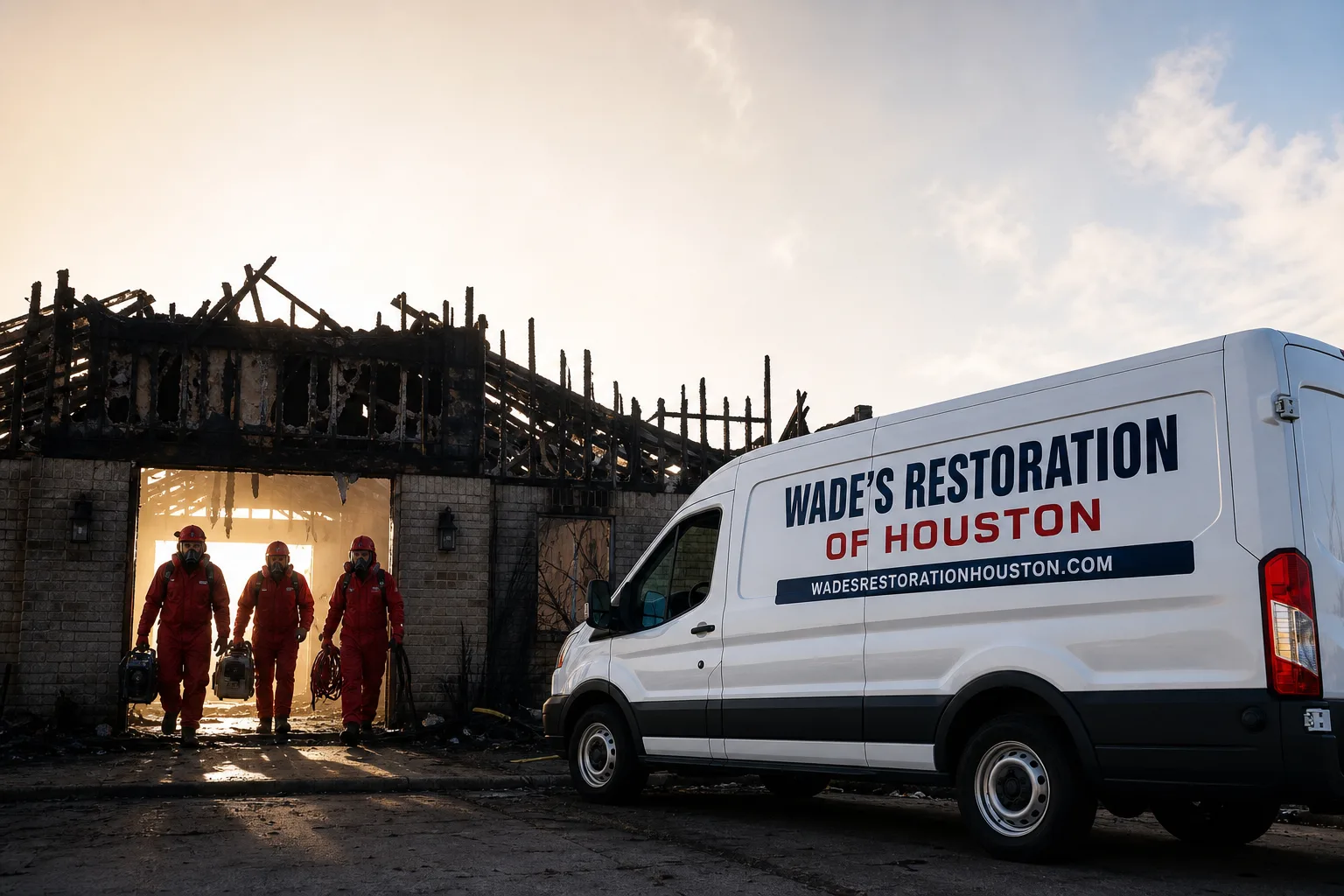
Fast, Reliable Storm & Disaster Restoration Across Willis
Storm damage in Willis doesn’t wait for business hours, and neither do we. When a June thunderstorm drops a loblolly pine limb through your roof off Lake Conroe Hills Drive, or a Gulf storm pushes floodwater up from the San Jacinto River watershed into your slab-on-grade subdivision off US-75, you need a crew that knows Willis not just another outfit running calls from a call center two states away. Wade Ferris founded Wade’s Restoration in 2007, and he answers the phone himself. We can have extraction running inside the hour. Call (888) 534-8116 now, any hour, and you’ll talk to a live person who knows exactly where Willis is and what a lakefront home on this side of Lake Conroe goes through.
We handle Storm & Disaster Restoration as the work it actually is: tarping a roof before the next rain band hits, pulling standing water out of a flooded slab home, and drying the boat-dock storage enclosure that almost every initial assessment misses. That last part is the one that separates Willis work from everywhere else. We’ll get to that.
Why Wade’s Restoration of Houston Is Willis’s Preferred Storm & Disaster Restoration Company
Willis homeowners have a memory. A lot of you lived through Harvey in 2017, watched the lake rise, watched the creek bottoms fill, and watched out-of-town crews write estimates that missed the real damage. The ones who showed up with a clipboard and a corporate script didn’t know that a Willis lakefront home has secondary structures below grade that hold standing humidity all summer. Wade does.
We’re not a franchise. Wade’s name is on the truck, his address is published, and he’s going to run into you again at the hardware store. That’s the oldest accountability mechanism there is, and it’s the one that keeps this company honest since 2007. Our crews serving Willis are background-checked and uniformed. They show up with professional-grade equipment: Dri-Eaz dehumidifiers, Phoenix air movers, XPOWER blowers, Injectidry systems, B-Air units. They carry IICRC certification and they do the work right.
The response time to Willis matters. When a storm comes through and your roof is open to the sky, every hour that passes lets water wick deeper into your framing and drywall. We coordinate dispatch from our Dallas-Fort Worth office, but crews stage locally so we’re not driving from two counties over while your ceiling sags. Call at 2 a.m. on a Sunday and a live person answers. Wade heads out.
Our Storm & Disaster Restoration Services in Willis
Storm Damage Cleanup
Wind-driven debris, fallen limbs, torn siding, scattered shingles. On the Willis side of Lake Conroe, the loblolly pine canopy is a beautiful thing right up until a squall line snaps a limb and puts it through your deck or your roof. We clear the debris, document the damage with photos for your adjuster, and secure the structure so the next rain doesn’t make it worse. In a 1970s wood-frame home downtown or in the older subdivisions, wind damage often opens up the exterior sheathing, which starts wicking moisture immediately. We get the exposed areas dried before mold gets a foothold.
Flood Damage Restoration
The 77318 and 77378 zip codes drain into the San Jacinto River watershed, and when the water comes up, it comes up fast in the low spots. A flash flood off US-75 can put six inches of standing water through a slab-on-grade tract home in an hour. We pump it out, pull the wet carpet and pad, set containment and air movers, and log moisture readings every single day until the structure’s back under 12% MC. You get the full moisture log at the end. Almost nobody in the trade hands that over. We do, because you should know what was done inside your own walls.
Emergency Board-Up
When storm damage leaves a window or door opening exposed, you need it boarded before the next storm, before wildlife gets in, before someone decides an open house is an invitation. We board up with plywood and fasteners sized to hold in Willis’s spring and fall wind patterns. Lakefront homes get stronger wind gusts off the open water, and a loose board is a hazard. We anchor it right.
Roof Tarping
A tarp is a temporary repair, but on a Willis lakefront home it has to hold until a roofer can schedule a permanent fix, which in a busy storm season might be two or three weeks out. We use heavy-duty tarps and secure them to the roof deck, not just weighted with 2x4s that the next thunderstorm slides off. Spring and fall winds off Lake Conroe will test a bad tarp job in one afternoon. Ours hold. We also document the tarp condition for your adjuster, because a failed tarp that lets more water in is usually a fight the homeowner loses without photos.
What happens when you call
- 1
A real person answersNo phone trees - you reach a local pro.
- 2
You get an upfront price rangeHonest numbers before anyone is dispatched.
- 3
A background-checked tech heads outLicensed & insured, dispatched right away.
- 4
You approve before work beginsNothing starts until you say go.
Trusted Brands We Service in Willis
We carry and service professional-grade equipment from XPOWER, B-Air, and Injectidry, which means the extraction and drying gear we run on Willis jobs is the same stuff commercial restoration techs use, not rental-counter leftovers. When we set an XPOWER air mover in a flooded slab home off Calvary Road or a B-Air dehumidifier in a boat-dock enclosure near Lake Conroe Hills, we’re running equipment that pulls water at the rate the job actually demands. And because our techs know these machines cold, we keep the drying curve short. That matters when every extra day of humidity in a Willis summer means mold is one step closer to taking hold.
Common Storm & Disaster Restoration Problems We See in Willis Homes
- Skipped boat-dock and below-grade storage enclosures. Out-of-town crews treat Willis like inland Montgomery County. They assess the main house, write the estimate, and never open the hatch on the boat-dock storage or the below-grade lakeside storage room. Standing water and 90% humidity in those spaces seeds mold in under a month, and you get the callback weeks after the main home is signed off. We check those spaces on every single Willis lakefront job.
- Pier-and-beam crawl spaces in the 1940s-1970s downtown core. The older wood-frame homes in Willis sit on crawl spaces that trap subtropical humidity year-round. When storm water floods under the house, saturated floor joists keep wicking moisture up into the living space long after the surface looks dry. Ignore the crawl space and you’ll be chasing musty odors and mold for years.
- Tight lakeside lots that starve the drying setup. Narrow driveways, boat trailers, and steep grades down to the water leave almost no room to stage equipment. Techs who don’t know Willis bring too few air movers or set them up in the wrong zone, and the drying curve stretches from days to weeks. We plan the equipment layout before we unload a single unit.
- Roof punctures from the loblolly pine canopy. Willis gets more than 50 inches of rain a year, and the pines shed limbs in every Gulf thunderstorm. A puncture that seems small lets water into the attic, and by the time the ceiling stain shows, the decking and insulation are already wet. We inspect the attic on every roof-tarping job, not just the visible damage.
Pricing for Storm & Disaster Restoration in Willis, TX
We Also Serve Cities Near Willis
Storm & Disaster Restoration in Willis keeps us busy, and the same crews handle work in Conroe, The Woodlands, Huntsville, and Spring. If you’re in one of those towns and the storm just came through, the same phone rings at (888) 534-8116.
Serving Willis, TX - Our Local Coverage Area
We’re based in the Willis area and know this community well. Use the map below to see our service coverage - if you’re nearby, we can almost certainly help.
FAQs - Storm & Disaster Restoration in Willis
After a storm on the Willis side of Lake Conroe, how do we know if our boat dock or lakeside storage took on water that could cause mold?
If the lake level rose or wind-driven rain hit the dock structure, assume the enclosure took on water until proven otherwise. Open the hatch and look for standing water, a high-humidity smell, or condensation on stored items. The real check is a moisture meter reading on the framing and the slab. We do that check on every Willis lakefront damage assessment, because the dock enclosure is almost never included in standard adjuster walkthroughs. If you’re not sure, call (888) 534-8116 and we’ll check it for you. No charge for the second opinion.
Why do so many Harvey-era homes in Willis have recurring mold in the crawl space even years after the flood?
Because the crawl space was never fully dried after the 2017 flood, and the subtropical humidity in the San Jacinto watershed keeps feeding the moisture load. Pier-and-beam homes in 77318, especially the 1940s-1970s wood-frame stock downtown, hold saturated joists and subfloor that wick moisture up into the living space every humid summer. The fix is not another bleach treatment. It’s structural drying to under 12% MC, which means removing the vapor barrier, running dehumidifiers in the crawl space, and logging daily readings until the wood actually dries out. We hand you the moisture log at the end. Most companies never will.
Can a roof tarp hold on a Willis lakefront home until a permanent repair, given the spring and fall storm winds?
Yes, if it’s anchored to the roof deck with enough fasteners and the seams are sealed. A tarp that’s just weighted down with 2x4s will lift in the first serious wind off Lake Conroe. We secure tarps to the deck, not the shingles, and we use enough fasteners that a 40 mph gust doesn’t peel it back. In a bad storm season, a tarp may need to hold for two or three weeks while roofing crews work through their backlog. Ours are built for that.
What is the fastest way to get standing water out of a slab-on-grade home in the new subdivisions off US-75 after a flash flood from the San Jacinto watershed?
Call the moment you see water. Standing water in a slab home in Willis’s summer heat starts moving up the drywall within hours. We respond to 77378 and 77318 immediately, pump the water out with truck-mounted extraction, pull the wet carpet and pad, and set air movers and dehumidifiers the same day. The sooner the drying starts, the less demolition you’re looking at. Call (888) 534-8116 and Wade heads out.
Our Willis home has 1970s wood siding and a pier-and-beam foundation-after a windstorm pulled off a section of siding, how long before the exposed framing starts to rot or grow mold?
In Willis’s climate, exposure is measured in days, not weeks. More than 50 inches of annual rain plus summer humidity above 80% means exposed framing starts supporting mold growth within 48 to 72 hours if it stays wet. Rot takes longer but starts the day the wood’s moisture content stays above 20%. We can tarp or board the opening the same day, dry the exposed framing, and replace the damaged siding section so you’re not looking at a bigger tear-out later. Call (888) 534-8116 and we’ll get it secured.
Written by Wade Ferris, Owner at Wade’s Restoration, serving Willis since 2007.