
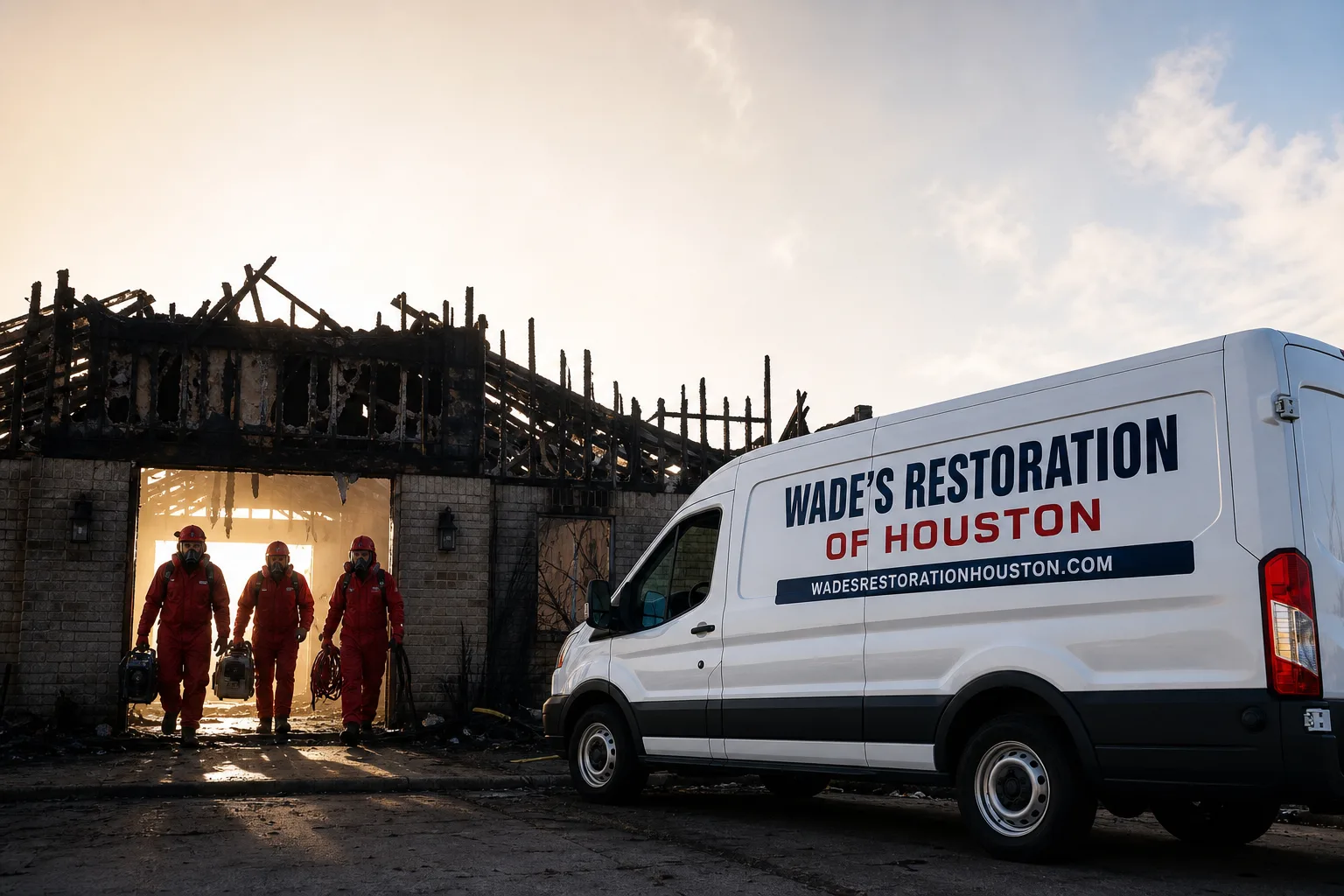
Fast, Reliable Mold Remediation Across Webster
Mold in a Webster home is not a wait-and-see problem. Between the bayou humidity, the age of the housing stock, and the way Clear Creek and Galveston Bay both push water into this corner of Harris County, mold colonization starts fast. Real fast. We answer the phone at (888) 534-8116 twenty-four hours a day, and Wade heads out to Webster the same day you call. No answering service. No runaround. Just a local crew that knows the difference between a water stain from a slab leak in Clear Lake City and moisture wicking up from a flood that never got properly dried. You need someone who treats mold as urgent, because in the 77598 ZIP, it is.
Why Wade’s Restoration of Houston Is Webster’s Preferred Mold Remediation Company
Wade Ferris started this company in 2007 and put his own name on the truck. That matters in Webster, where houses are close together, neighbors talk, and the guy who quoted one price over the phone then showed up with a different one is remembered for years. Wade publishes his address and license number. He answers his own phone at 2 a.m. when a Clear Creek backup wakes you to wet carpet. And every mold job gets the 90-Day Done Right Promise in writing: if it is not done right, he makes it right. No fine print, no callback runaround. You call back, Wade comes back.
The crew we send to Webster is background-checked, uniformed, and IICRC-certified. We do not subcontract to whoever is available. The people who walk through your door on East Broadway Street or off West League City Parkway are Wade’s people, trained on the exact equipment we use: Dri-Eaz, Phoenix, Injectidry, and B-Air. For older ranch homes near NASA Parkway, that equipment matters more than most people realize. A box fan from the garage cannot pull moisture out of a 1960s slab-on-grade foundation. We bring commercial-grade drying and we take moisture readings daily. You get the full log at the end. Almost no one else in this trade hands that over, and we think you should see exactly what we measured, every single day.
Our Mold Remediation Services in Webster
We handle the full scope of mold work in Webster, from initial testing through structural drying and treatment. Here is what that looks like day to day.
Mold Inspection & Testing
A visible patch of black on drywall is one thing. What you cannot see behind the wall is what worries us. In Webster, where storm surge and Clear Creek flooding both occur, water can enter a house through the slab, travel up the sill plate, and create mold inside wall cavities nobody has opened in fifty years. We do visual inspection first, then recommend air sampling or surface testing when the source is not obvious. If you have already gotten a written estimate from another company, bring it to us. Wade offers a free second opinion on any written estimate, and he will tell you straight what is necessary and what is not.
Mold Removal
Mold removal in Webster homes typically runs $1,500 to $4,000 for contained removal from a single room or hallway, but small jobs under a sink can run as low as $400 to $700. Larger sections of a flooded Clear Lake City ranch home can reach $6,000 to $10,000 when multiple rooms are involved. We set up proper containment with negative air pressure, remove affected drywall and insulation, HEPA-vacuum surfaces, and treat remaining framing. Mold Remediation is not a wipe-down with bleach. It is controlled demolition of damaged material plus drying plus treatment, done in that order. Skip the drying or skip the containment and you will be calling someone back in eight weeks.
Black Mold Remediation
Black mold gets the headlines, but the truth is simpler: any mold growing in your Webster home is a water problem first and a mold problem second. Stachybotrys, the black mold you hear about, loves drywall and paper backing that stayed wet for days. That happens in Webster after slab flooding when sill plates and stud cavities never dried. Remediation for black mold in a single bathroom or closet here usually runs $1,200 to $3,800. Whole-home jobs after a flood event can run $8,000 to $15,000. We contain the space, remove the material, dry the structure, and document everything for your adjuster. If insurance is involved, Wade deals with the adjuster directly. You do not carry information back and forth.
Air Quality Restoration
After the visible mold is gone, the air in the house often still carries elevated spore counts. In Webster’s humidity, that problem can linger for weeks if you do not address it. We run air scrubbers, replace HVAC filters, and in some cases clean duct runs that pulled mold spores during the event. For older Clear Lake City homes built with the original ductwork from the 1960s and 1970s, this step matters. You can tear out moldy drywall and still wake up stuffy. Air quality restoration is how we close the loop.
Moisture & Humidity Control
This is the service most Webster homeowners actually need before mold becomes visible. The year-round Gulf humidity above 75% means moisture becomes a chronic problem even without a storm. Crawl space encapsulation, dehumidifier installation, and sealing foundation vents are the workhorses here. A standalone dehumidifier install in a Webster crawl space typically runs $1,800 to $3,200. Full encapsulation with vapor barrier, sealed vents, and a commercial dehumidifier runs $6,000 to $12,000 depending on square footage. If you are chasing a musty smell that comes back every summer, this is where the fix usually lives.
Crawl Space Treatment
Webster has a mix of slab-on-grade and pier-and-beam homes, and the pier-and-beam ones have a particular mold problem: standing water under the house after a flood, then humidity trapped under the floorboards. We treat crawl spaces with moisture barriers, drainage correction, and antimicrobial application on affected joists. The work is not glamorous, but it is often the difference between a house that dries out and a house that smells like a basement forever. In the 77598 ZIP, where Clear Creek flooding repeatedly puts water under homes near Red Bluff Road, this service is not optional after a flood.
What happens when you call
- 1
A real person answersNo phone trees - you reach a local pro.
- 2
You get an upfront price rangeHonest numbers before anyone is dispatched.
- 3
A background-checked tech heads outLicensed & insured, dispatched right away.
- 4
You approve before work beginsNothing starts until you say go.
Trusted Brands We Service in Webster
We do not use rental equipment or homeowner-grade tools. The gear on our trucks is the same stuff restoration professionals across the country run: Dri-Eaz dehumidifiers and air movers, Phoenix axial fans, and Injectidry injection drying systems for wall cavities and under cabinets. Our crew carries IICRC certifications, and our processes follow RIA and IFA guidelines. That matters most in Webster because the humidity here punishes shortcuts. A dehumidifier that works fine in a dry Dallas summer will run continuously in a Webster garage and barely move the needle on moisture content. This is not marketing language. It is what we see on job sites every week, including the ranches along NASA Parkway where the original drywall has been soaking up Gulf air for sixty years.
Common Mold Remediation Problems We See in Webster Homes
- Humidity-driven mold in sealed wall cavities after slab flooding. Water wicks up through the sill plate and into studs, then the wall is sealed back up before the cavity is dry. The mold returns within weeks. We open the wall, dry the cavity with Phoenix air movers and Dri-Eaz dehumidifiers, and only then close it back up.
- Homeowners using box fans and household dehumidifiers. In 75%+ Gulf humidity, those units cannot lower moisture content fast enough to stop colonization. You are running electricity for nothing. By the time we arrive in Webster after a homeowner tried this for a week, the mold has usually spread farther than the original water damage.
- Demolishing drywall without addressing water in the sill plate. The wall looks dry, so the drywall goes back up. Meanwhile, the bottom plate is still wet and wicking moisture upward. Months later, mold blooms at the baseboard line. We see this constantly in 1960s Clear Lake City homes with original bottom plates.
- Hidden mold behind original 1960s drywall after minor floods that never made the news. Webster floods in ways that do not get regional headlines. A moderate tropical system pushes a few inches of water across slabs on Landon Lane, the water recedes, and nobody thinks about the wall cavities. Then the smell starts. We know this pattern by name.
Pricing for Mold Remediation in Webster, TX
- Inspection and testing: $200 to $450 for a visual inspection with basic moisture mapping. Add $300 to $600 for air sampling and lab analysis.
- Small contained removal (one bathroom, closet, or under-sink area): $400 to $1,200.
- Single-room mold removal with containment and drying: $1,500 to $4,000.
- Whole-home remediation after a Clear Creek or storm surge flood: $8,000 to $15,000.
- Crawl space dehumidifier installation: $1,800 to $3,200.
- Crawl space full encapsulation: $6,000 to $12,000.
What moves the number? Square footage of affected material, whether we need to remove and replace drywall versus dry in place, whether HVAC ducts need cleaning, and how long the building sat wet before we arrived. We do not charge trip fees inside our own county, so if you are in Webster and want an estimate, there is no charge for coming out. Wade walks every job himself. You get a written scope before any work starts. No surprise line items, no phone quote that changes at your door. Call (888) 534-8116 and we will head your way.
We Also Serve Cities Near Webster
If you are in Friendswood, League City, Seabrook, or Pasadena, the same crew covers you. A lot of our Webster customers ask us to check on a parent’s house in League City or a rental property in Friendswood, and we are glad to. Mold Remediation in Webster is our focus, but the whole Clear Lake area is our neighborhood. Call us from anywhere in the 77598 and surrounding ZIP codes and we will be there.
Serving Webster, TX - Our Local Coverage Area
We’re based in the Webster area and know this community well. Use the map below to see our service coverage - if you’re nearby, we can almost certainly help.
FAQs - Mold Remediation in Webster
How quickly can mold start after Clear Creek overflows into my Webster home?
Mold colonization can begin within 24 to 48 hours after floodwater enters your home. In Webster’s climate, with humidity routinely above 75%, that timeline is often on the faster end. The first 24 hours are for water extraction and initial drying. The next 24 are for opening affected walls and starting antimicrobial treatment. If you wait a week, you are usually looking at tear-out and replacement rather than drying in place. Call (888) 534-8116 as soon as the water recedes, and we can have equipment running the same day.
Do I need mold testing after a flood in the 77598 ZIP code, or just visual inspection?
Visual inspection and moisture mapping are usually sufficient to start remediation work. Testing becomes valuable when you need documentation for an insurance claim, when you are selling a home, or when visible mold does not match the extent of the smell. We will tell you honestly if testing is necessary. We do not upsell sampling on every job. In Webster, where the dual flood risk creates hidden moisture in wall cavities, there are times when testing is the only way to know if the air is actually clean after remediation.
Can I save my original 1970s drywall after a minor flood on Red Bluff Road?
Usually not. Drywall that has absorbed floodwater, even for a few hours, wicks moisture upward and turns into a mold food source. In a 50- to 60-year-old Webster home, that drywall also has decades of accumulated dust and organic material in the wall cavity. The realistic answer for most Red Bluff Road ranches: cut the wet drywall, dry the studs and sill plate, treat the framing, and install new drywall. Trying to save it almost always costs more in the long run. Call us for a straight answer on your specific wall.
Why does my Webster home smell musty weeks after a storm even though everything looks dry?
Because something behind the visible surfaces is still wet. The most common culprit in Webster is the sill plate, the bottom horizontal framing member that sits on the slab. Water wicks into it during slab flooding, then stays wet for months while the drywall in front of it dries out. Another culprit is the crawl space under a pier-and-beam home that never got dried or treated. The musty smell is mold metabolizing somewhere you cannot see. We trace it with moisture meters and open the wall only where the readings tell us to.
Does mold remediation in Webster require different containment than inland Houston neighborhoods?
Yes. Webster’s dual flood risk means homes here often have two or three separate moisture sources from the same storm, which means mold can be present in disconnected areas: the garage wall that took storm surge, the living room wall that took Clear Creek backing up through the floor drain, and the closet that wicked from the slab. Each area needs separate containment and drying protocols. A single containment zone over the whole house does not work when the mold is in separate, disconnected pockets. That is the biggest difference we see between Webster jobs and inland work, and it is why we always map moisture across the entire floor plan before setting up. Call (888) 534-8116 for an inspection and we will show you exactly what we mean.
Written by Wade Ferris, Owner at Wade’s Restoration of Houston, serving Webster and the Clear Lake area since 2007.